

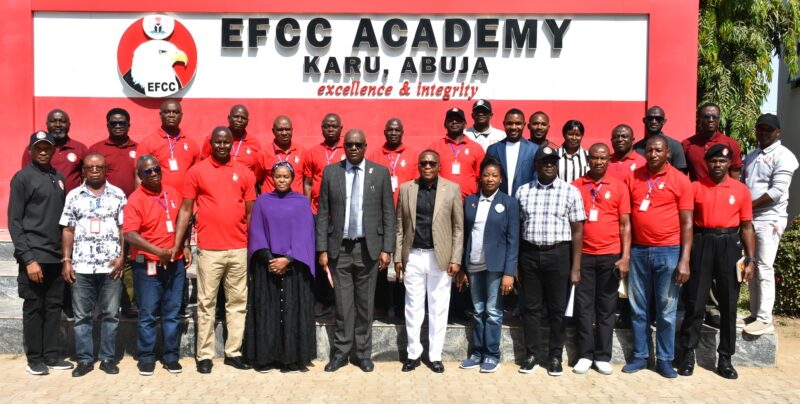

The Executive Chairman, Economic and Financial Crimes Commission, EFCC, Mr Ola Olukoyede, has charged retiring officers of the Commission to be adequately prepared and arm themselves with the knowledge, practical skills and mindset required for a fruitful and fulfilling life after active service.
He gave the charge on Thursday, November 18, 2026 while addressing the officers at the conclusion of the maiden Pre-Retirement Training Programme, held at the EFCC Academy, Karu, Abuja.
The three-week programme, which ran from November 2 to 19, 2026, was the first of its kind in the Commission and underscored management’s commitment to the welfare of personnel beyond their years of active service.
Represented by the Director, Administration and Human Resources, Commander of EFCC, CE Femi Gbarufu, Olukoyede explained that the training was conceived to prevent situations where retirees, despite receiving retirement benefits, encounter avoidable financial difficulties due to poor investment decisions and inadequate management.
“We want our staff, by the time they retire, to have a fruitful retirement. Not the one that you have an investment you can’t properly manage, where the thing will snowball into issues and you cannot just put yourself together. So, we said, okay, let’s just put up a plan that will guide you and be very impactful. And I’m glad that those of you who passed through this training have felt a great impact, which means all that you were taught sank into you, judging from the way you were speaking, and I’m happy to note that,” he said.
He further explained that with the successful completion of the inaugural programme, the EFCC has set a foundation for a more structured approach to retirement preparation, ensuring that officers who have devoted years to national service can look forward to life after retirement with confidence, purpose and renewed possibilities.
Earlier in his welcome address, the Acting Commandant, EFCC Academy, Karu, Abuja Assistant Commander of EFCC, ACE I Joseph Ogwiji, described pre-retirement training as an established global practice that provides workers approaching retirement with the necessary preparation for life outside active service.
“This is a practice all over the world that, at the very edge of retirement, there should be a training package that will give retiring officers the required practical skills, financial guidance and mindset preparation towards what they intend to do outside service, and this is what we have done,” he said.
Ogwiji observed that the difficulties some retirees experience after leaving active service were not necessarily attributable to inadequate retirement benefits but could also result from poor financial planning and management.
He explained that the EFCC initiated the programme to address such challenges by equipping its retiring personnel with relevant knowledge and practical guidance to make informed decisions, manage their resources and explore viable opportunities after service.
In her goodwill message to the graduating participants, Deputy Commandant, Training, EFCC Academy, Assistant Commander of EFCC, ACE1 Halima Rufau, congratulated the officers on the successful completion of the programme and commended them for their years of dedication and sacrifice to the Commission.
“I congratulate our senior citizens for the successful completion of this training and salute the years of service, sacrifice and integrity you have given to the EFCC. Your legacies will not be forgotten. The EFCC values you beyond your payroll, and your experiences remain an asset to the anti-corruption struggle. As you leave active service, remember that the EFCC brand does not retire with you; you remain its ambassadors,” she said.
Providing an overview of the three-week programme, the Course Coordinator and Head of the Capacity Development Unit, Assistant Commander of the EFCC II Joy Idoko, said the training was structured to prepare participants for a smooth, well-informed and honourable transition into retirement.
According to her, the participants were exposed to a wide range of subjects, including retirement transition, pension administration, financial and investment planning, introduction to agribusiness, entrepreneurship, real estate and property investment, as well as health and wellness management.
She added that the programme featured an on-site visit to AGA Farms located in Nasarawa State, where participants undertook an excursion and practical sessions on agribusiness opportunities, giving them firsthand exposure to viable investment and entrepreneurial prospects.
“The overall aim of the training is to prepare the officers for a smooth, well-informed and honourable transition,” Idoko said.