
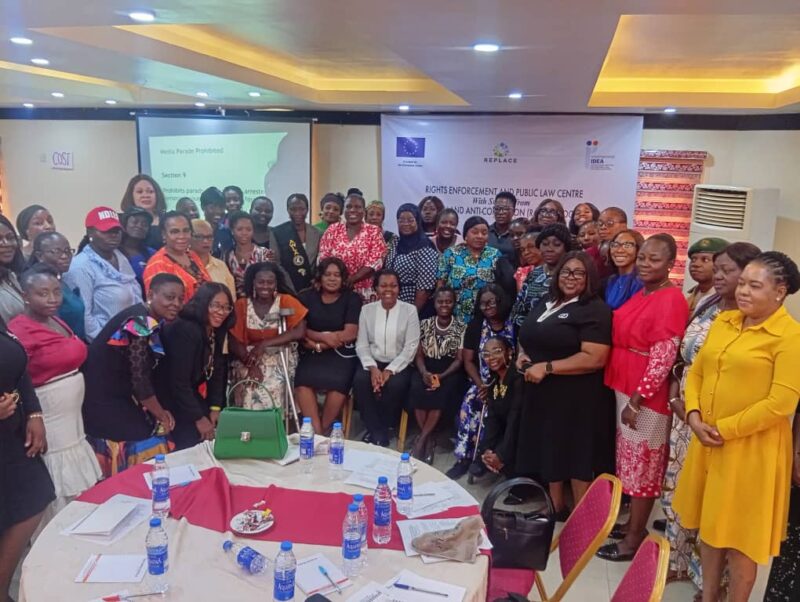

Women leaders, lawyers, business owners, journalists and civil society advocates gathered in Lagos to examine how the Lagos State Administration of Criminal Justice Law (ACJL) can better protect women and vulnerable persons, amid concerns that many of its groundbreaking provisions remain largely unknown and underutilised more than a decade after its enactment.
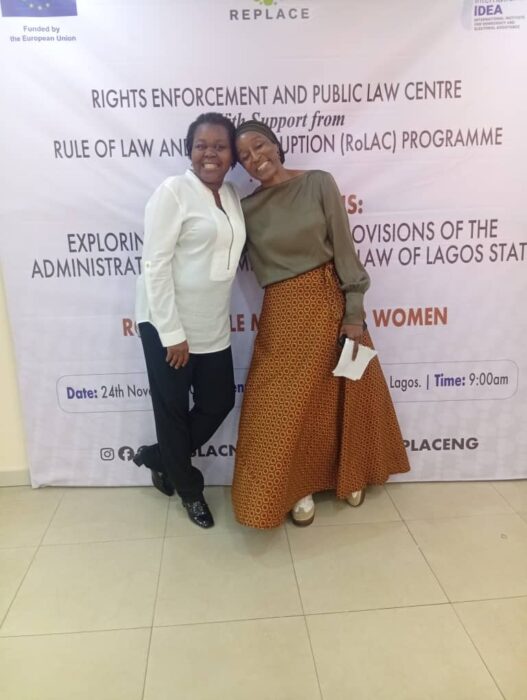
The roundtable meeting was organised by the Rights Enforcement and Public Law Centre (REPLACE), with funding from the European Union and support from International IDEA. The event was held on 24 November 2026 in Maryland, Ikeja, Lagos State.
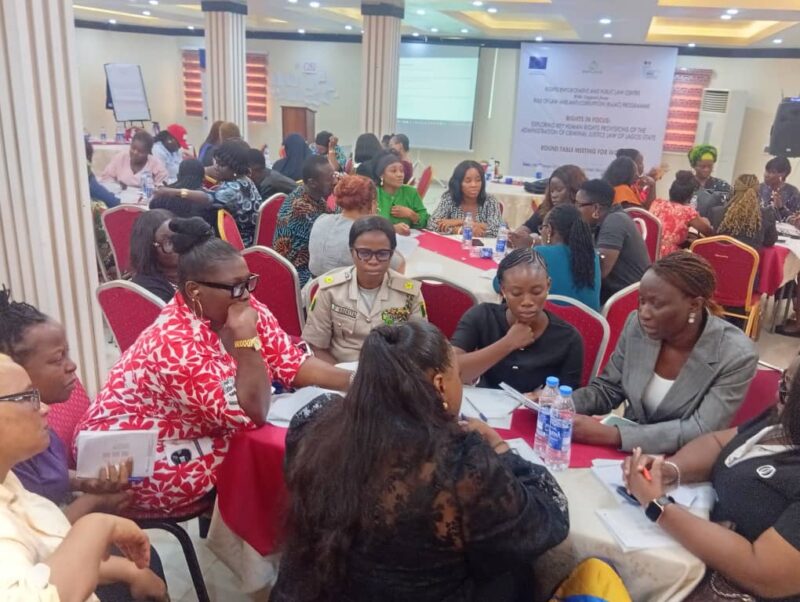
The forum sought to strengthen collaboration among women-led and women-focused organisations, professionals, businesses and faith-based groups to promote implementation of the human rights provisions contained in the ACJL. Participants also discussed developing a referral framework for victims of human rights violations and complaints in Lagos State.
The gathering brought together representatives of civil society organisations, legal practitioners, professional women, entrepreneurs and members of the media.
Organisers said the objectives included improving participants’ understanding of key ACJL provisions relating to women and vulnerable persons, identifying practical roles organisations can play in documenting and referring human rights complaints, and establishing coordination mechanisms for justice referrals.
A highlight of the event was a presentation by the Executive Director of REPLACE, Ms Felicitas Aigbogun-Bra, who described the ACJL as one of Nigeria’s most progressive criminal justice laws, particularly on women’s rights.
According to her, despite the law’s innovative provisions, awareness among both citizens and law enforcement agencies remains low.
“The Administration of Criminal Justice Law of Lagos State contains provisions without precedent in Nigerian legislation, especially for women and vulnerable persons,” she said. “Eleven years after its enactment, awareness and compliance remain low among police officers and the public.”
Aigbogun-Brai traced the evolution of criminal justice laws in Nigeria, explaining that the Constitution, Criminal Code, Penal Code and laws governing evidence and criminal procedure provide the framework within which criminal offences are investigated and prosecuted.
“For you to be charged with any offence, the offence must be an offence that has been identified and written,” she explained. “If the police arrest you, the offence must be defined in a law.”
She said procedural laws regulate what happens after an arrest, including which agency investigates, prosecutes and adjudicates criminal matters.
The criminal justice system, she noted, involves not only the police and courts but also institutions such as the Ministry of Justice, correctional services, the Legal Aid Council of Nigeria, the National Human Rights Commission, and civil society organisations that support victims and defendants.
Aigbogun-Brai recalled that Lagos enacted the ACJL in 2015 and updated it in 2021. Although the federal Administration of Criminal Justice Act (ACJA) later gained wider recognition, she noted that Lagos pioneered many reforms.
“If you are arrested for a crime in Lagos State, then the ACJL is one piece of legislation that will guide the process from the time you are arrested to either when you are convicted or when you are released by the courts,” she said.
According to the legal practitioner, one of the law’s greatest strengths is its explicit recognition of women’s rights, an area she believes had previously been neglected in legislation.
“I can beat my chest and say, never have you seen this kind of specific reference to the rights of women,” she said.
She stressed that laws cannot achieve their purpose if citizens remain unaware of them. “You can’t have a piece of legislation, and it just sits on the shelf.”
She acknowledged that many civil society organisations have invested years in awareness campaigns and engagements with police officers, lawyers, correctional officials and members of the judiciary.
“Police officers have told me, ‘ Why would they comply with this? Why would they change their systems?” she said.
She cited the legal requirement that confessional statements be video recorded as an example of reforms designed to reduce torture and coercion during investigations.
“A lot of police officers will not be interested,” she said. “They may not know that the provisions exist, and they won’t do anything about it.”
Her organisation, she said, received a grant under the Rule of Law and Anti-Corruption Programme (ROLAC) in 2024 to raise awareness among stakeholders.
“Just let people know that this exists. Some of these provisions are quite innovative. Why don’t you start using them?, she asked rhetorically.
Aigbogun-Brai used the forum to draw attention to several sections of the ACJL that directly affect women.
On arrests, she said the law prohibits unnecessary restraint.
“Except that person poses a flight risk or poses some kind of danger to the arresting officers, you should not restrain the person,” she said.
Questioning the routine use of handcuffs, she added: “You see someone in handcuffs, and you’re wondering why. Or someone who has been beaten black and blue and you’re wondering why.”
Section 3 of the law requires police officers to inform suspects of the reason for arrest unless they are caught committing the offence, she said.
However, she argued that this requirement is often ignored.
“In the many years I have practised in the NGO sector, they (Law enforcement officers) do not routinely tell people why they have arrested them,” she said.
She encouraged citizens to learn to ask questions respectfully when approached by law enforcement officers.
She noted: “We need to learn to speak to power. Not in a rude manner, and you don’t have to fight. Someone is carrying a gun; you need to respect yourself, but we need to learn to just ask questions.”
She also cautioned individuals against reporting alone to police stations.
“Even if you call me, I will not go alone to the police station. I will call my friends to go with me.”
The lawyer reminded participants that suspects have a constitutional right to remain silent and to consult a lawyer before making statements.
“When law enforcement officers ask you a question, just very calmly ask, ‘Can I call somebody? Can I call my lawyer?’ Because the law actually says that you have the right to remain silent.”
One of the most significant reforms under the law, she said, is the prohibition of arresting relatives or associates in place of suspects.
Section 4 expressly states that no person shall be arrested in place of another.
“If somebody is looking for your brother, they come to your house, they don’t find him, they will carry you,” she said.
“If they come to your shop, they are looking for your shop girl; they don’t find her, they will carry her to the station.”
She described the practice as one historically used to pressure wanted persons into surrendering.
The law also regulates searches, requiring that they be conducted with dignity, respect and privacy, and by officers of the same sex.
“A man cannot do a body search for a woman,” she emphasised.
Perhaps one of the most debated provisions discussed at the meeting was the right of women to stand as sureties.
Under Section 17, any person who meets bail conditions may act as a surety, including women.
“It’s not normal for a law to be so specific,” she said.
“But based on our social and cultural context, the drafters felt they needed to be specific.”
She recounted how some police officers resisted the idea during a training session in December 2024.
One officer reportedly argued that women would be unwilling to produce suspects who absconded.
Another insisted law enforcement officers would not be able to compel women to comply.
Aigbogun-Brai disagreed: “We have to move past the way we’ve been doing things. The law says a woman can stand surety. So, a woman must be able to stand surety.”
She explained that the legal process already provides remedies if a surety fails in their obligations.
“If somebody jumps bail, you can go to court and have an order so that you arrest the woman,” she said. “Go through the process of the law.”
Despite efforts to track implementation of the provision, she lamented the lack of available data.
“As I stand before you, we have not been able to get any information from any police station.”
Aigbogun-Brai also raised concerns over the misuse of police powers in civil and contractual disputes.
She explained that court decisions and the ACJL make clear that the police are not debt collectors.
Yet many women continue to face detention over disagreements arising from personal loans, instalment payments and failed business transactions.
“Those of us who go to prisons will generally find some women who are there because they borrowed money and couldn’t pay back,” she said.
“People often misuse the police. This person has refused to fulfil her contractual duties; I will use the police. This person has annoyed me; I will use the police.”
She urged women to understand their legal rights. “A lot of women fall into that trap,” she said.
The lawyer also criticised the continued practice of parading suspects before the media before trial.
“This idea of putting these suspects on television, basically subjecting them to public scrutiny when a court has not declared them guilty of a crime, is something the law expressly forbids,” she said.
She noted that suspects are often presented in a manner that creates public bias and undermines their presumption of innocence.
Another provision that generated discussion was Section 144, which affirms that married women can own property in their own names.
“I was like, ha, it has reached like this, that a law has to say married women can own property in their own name,” she said.
She argued that cultural and religious practices often discourage women from asserting economic independence.
“The drafters must have concluded that many women either wrongly believe they cannot own property or are prevented from doing so.”
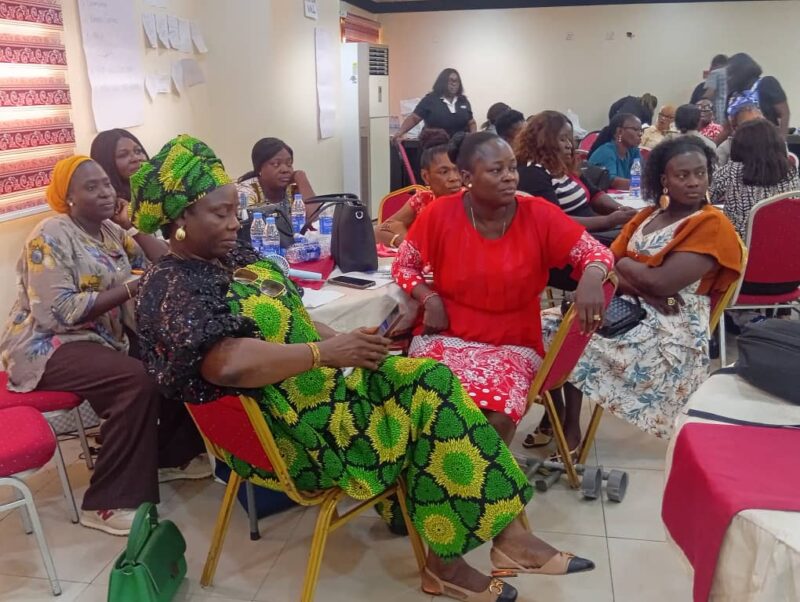
The interactive session was facilitated by Ms Maryam Aliko Mohammed, who identified several barriers preventing women from accessing justice.
According to her, women who desperately need help are often constrained by lack of knowledge, fear, financial limitations, distrust of institutions and systemic challenges.
Participants engaged in plenary discussions on barriers women face when reporting human rights violations and seeking justice.
A working session focused on co-designing a referral framework for human rights violations and complaints in Lagos State.
Group exercises and presentations examined issues including support pathways for abused domestic workers, responses to sexual violence against students, interventions for female inmates, and legal responses when civil disputes are converted into criminal cases.
Discussions also explored strategies for assisting women experiencing domestic violence.
At the end of the meeting, participants contributed information for a proposed directory of organisations and service providers that support women seeking justice.
The directory, organisers said, will be refined and formally launched to help women identify appropriate sources of assistance without having to “run from pillar to post” in search of help.