
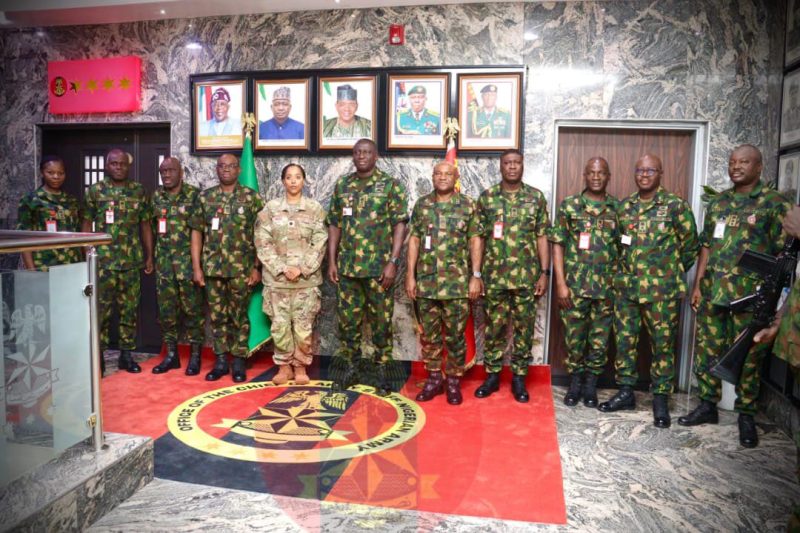

The Chief of Army Staff (COAS), Lieutenant General Waidi Shaibu, has called for a significant deepening of strategic cooperation between the Nigerian Army and the United States Army to better address the nation’s complex security landscape.
The Army Chief appealed on Wednesday during a courtesy visit by the United States Defence Attaché to Nigeria, Lieutenant Colonel Semira Moore, at the Army Headquarters in Abuja.
Highlighting the “evolving and multifaceted” nature of Nigeria’s security challenges, Lt. Gen. Shaibu noted that international military alliances are vital to the country’s peace and stability. He specifically pointed to the long-standing professional bond between the two nations as a foundation for future success.
“The Nigerian Army has benefitted immensely from American military professionalism and institutional expertise,” Lt. Gen. Shaibu stated. “The fact that several Principal Staff Officers are alumni of renowned United States professional military institutions is a testament to the depth and impact of this bilateral relationship.”
The COAS emphasised that the Nigerian Army is eager to leverage U.S. experience in both kinetic (combat) and non-kinetic (civil-military) operations. He advocated for expanded cooperation in several key areas: Operational effectiveness and institutional capacity, Doctrine development and Strategic capability enhancement.
In response, Lieutenant Colonel Semira Moore reaffirmed the United States’ dedication to the partnership, describing the relationship between the two armies as “cordial and mutually beneficial.”
“We remain committed to strengthening existing ties while exploring new areas of collaboration,” Moore said. “Specifically, we are looking toward increased capacity building, intelligence sharing, and joint operational planning.”
Beyond frontline combat support, Lt. Col. Moore disclosed that the U.S. would continue to prioritise non-kinetic support, which is often the backbone of long-term stability.
This includes humanitarian assistance programmes and troop welfare initiatives aimed at sustaining morale in the field.
The meeting concluded with both leaders agreeing that a robust military-to-military relationship is essential for complementing Nigeria’s internal security architecture and advancing sustainable peace in the region.