

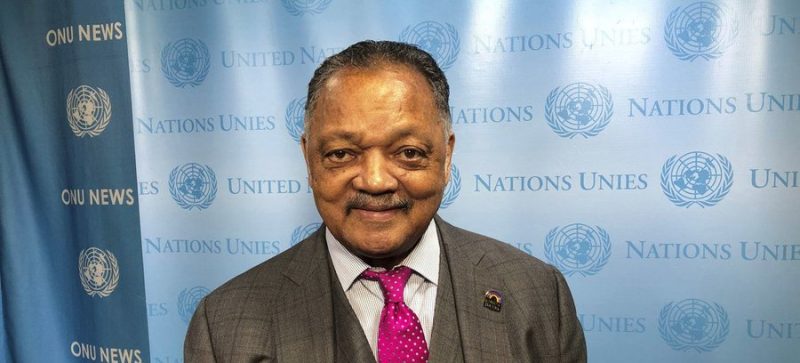

President Bola Ahmed Tinubu has joined global leaders in mourning the death of American civil rights icon and Baptist preacher, Reverend Jesse Jackson, describing his passing as a major loss to the global struggle against insecurity, injustice and human rights violations.
In a condolence message issued on Tuesday, the President said Jackson, who died at the age of 84, dedicated his life to advocating for the rights of oppressed and marginalised communities, particularly in the United States of America and across the world.
Tinubu noted that Jackson rose to prominence as a young activist working alongside renowned civil rights leader Martin Luther King Jr., championing racial equality, social justice and human dignity at a time of widespread discrimination and racial insecurity.
The President described Jackson as a servant-leader whose activism strengthened global advocacy for social and economic justice for African-Americans and other vulnerable populations. He added that Jackson continued the struggle for racial equity and civil liberties after King’s assassination, helping to sustain global attention on systemic oppression and inequality.
Reflecting on his personal experience as a student in the 1970s in Chicago, Tinubu said he witnessed Jackson’s grassroots mobilisation against injustice, noting that the cleric played a critical role in promoting democratic values and human rights awareness.
Tinubu further credited Jackson’s political influence with helping to shape inclusive governance in America, stating that the emergence of Barack Obama as the first Black American president was built on the foundation laid by Jackson’s earlier presidential bids in 1984 and 1988.
The Nigerian leader also highlighted Jackson’s role in international human rights advocacy, particularly his resistance against apartheid in South Africa and his involvement in campaigns demanding the release of anti-apartheid leader Nelson Mandela and other members of the African National Congress.
Tinubu emphasised that Jackson’s interventions extended to Nigeria during periods of military rule, where he advocated for democratic governance and civil liberties. He recalled that Jackson served as Special Envoy to Nigeria and Africa under the administration of Bill Clinton between 1997 and 1999, helping to foster diplomatic engagement and democratic reforms.
According to the President, Jackson also strengthened ties between African leaders and the Congressional Black Caucus, helping to amplify Africa’s interests in global policymaking spaces.
Jackson’s activism dates back to the height of racial tensions and political unrest in the United States during the 1960s and 1970s, when civil rights advocates faced violent repression, systemic discrimination and socio-economic exclusion. His leadership helped mobilise non-violent campaigns that demanded voting rights, economic inclusion and protection from racially motivated violence.
Beyond street protests, Jackson founded Operation PUSH in 1971 to promote economic empowerment and social justice for Black Americans. He later expanded the initiative into the Rainbow PUSH Coalition, which focused on political inclusion, voter education and social welfare advocacy.
Jackson’s international engagements also positioned him as a mediator in conflict and governance crises across Africa and the Caribbean. During Nigeria’s prolonged military era, particularly under the regime of Sani Abacha, Jackson was among the global voices that raised concerns over human rights abuses, suppression of dissent and political detentions, contributing to sustained international pressure for democratic transition.
His advocacy extended to campaigns against apartheid, where he mobilised diplomatic and economic pressure that strengthened global sanctions against the segregationist regime in South Africa. Analysts widely credit such international solidarity movements with contributing to the eventual dismantling of apartheid and the restoration of democratic governance in the country.
Throughout his career, Jackson remained a vocal advocate for peaceful conflict resolution, social justice and inclusive governance, frequently emphasising the need to address structural inequality as a root cause of insecurity and social unrest.
Tinubu described Jackson’s life as a symbol of resilience against discrimination, insecurity and rights violations, noting that his advocacy reinforced global calls for justice, equality and democratic accountability.
He urged world leaders and citizens to uphold Jackson’s message of hope and unwavering commitment to human rights, stating that his legacy remains relevant in addressing contemporary security and governance challenges across Africa and beyond.
The President prayed for the repose of Jackson’s soul and extended condolences to his family, associates and global supporters of civil rights.