

By Juliana Francis
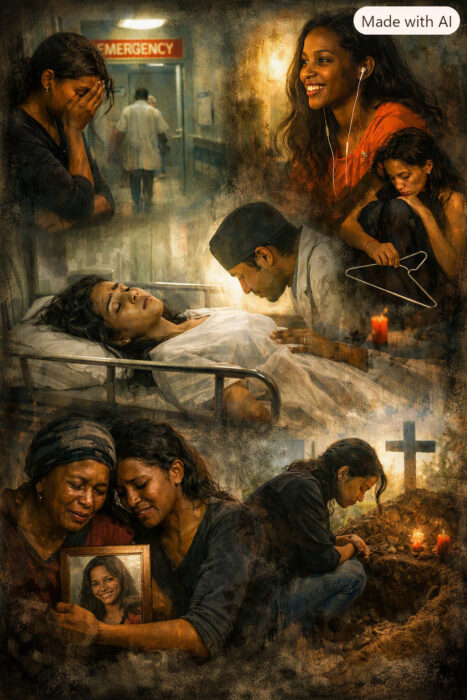
Pain, despair, and a hint of helplessness crisscrossed Amaka’s face as she recalled the events leading to the death of her younger sister, Uju, about four years ago.
As Amaka struggled to rein in her emotions, she failed, and tears filled her eyes, running down her cheeks.
The reporter spoke with her in Ijegun, Alimosho Local Government Area of Lagos State, where her family resides. This was also where Uju lived until her death.
Uju died just months after being admitted to Abia State University. Her dream of becoming an ace journalist in Nigeria died with her.
Almost choking with emotion, Amaka whispered brokenly: “We were like Siamese twins. People called her my handbag. We were so close. Yet, when she got pregnant, she didn’t tell me. Instead, she resorted to an abortion and died. To this day, I’m still asking myself why she didn’t tell me, why she didn’t keep the pregnancy. We’ve never gotten over her. The shock killed our father, and since then, our mother has never been the same.”
Amaka, a Nollywood makeup artist, said 22-year-old Uju died from complications arising from an unsafe abortion.
The late Uju was not only close to her, but she was also her father’s favourite. Her death devastated the entire family and eventually contributed to their father’s death. Although it happened some years ago, the trauma still lingers.
On the day the family discovered that Uju had undergone an abortion, Amaka was on a movie set in the Ikorodu area of Lagos State.
She later called Uju to come over, as she usually did, to assist on set. However, Uju sent her a video showing that she was receiving intravenous fluids at home, telling Amaka that she was not feeling well.
Amaka said, “She said it was malaria. The next day, my elder sister called to tell me Uju had had an abortion. None of us knew she was pregnant. She even told the nurse treating her that she had malaria. The nurse gave her antibiotics without running any laboratory tests.
“Nobody would have known if my elder sister hadn’t discovered blood-soaked clothes in a bucket, which revealed what had happened. When Uju was confronted, she admitted to the abortion.”
Alarmed by the amount of blood on the clothes, the family rushed her to a private hospital.
“A doctor there performed an evacuation and even removed the baby’s hand. Her condition was already critical, so she was referred to another hospital and eventually to the Lagos University Teaching Hospital (LUTH),” Amaka recalled.
At LUTH, the family was asked to pay ₦350,000 before Uju would be moved to the Intensive Care Unit (ICU), but they could only raise ₦200,000.
According to Amaka, the hospital declined to commence treatment until the full amount was paid.
She said that when the medical staff noticed Uju’s condition had become critical and that she was slipping away, they reluctantly agreed to accept the ₦200,000.
Amaka narrated: “There was no electricity to operate the lift, and the staff were nonchalant. I ran to plead with the man in charge of the generator, but by the time I returned, my sister was gasping for air. She held my hand tightly, apologised repeatedly, and then passed away right there in the hospital walkway.
“I carried her body myself, still hoping she could be revived. But when I saw her covered up, I knew she was gone. The loss devastated our family.”
Avoidable deaths like Uju’s continue to occur in Lagos State because the criminalisation of abortion forces many women and girls to seek unsafe, self-induced abortions or rely on unqualified providers instead of accessing safe medical care.
After Uju’s death, her siblings went through the messages on her phone. One of the chats was with someone saved as “Nurse.”
When the family traced the woman to her home, a single room in a rundown neighbourhood, they discovered she had fled after carrying out another fatal abortion, prompting another bereaved family to search for her.
Amaka described the nurse as a quack.
“Seeing Uju’s friend’s child all grown up today makes me wonder why she didn’t keep hers. But we can’t turn back time,” Amaka said.
Amaka believes abortion should be legalised in Nigeria so that women can walk into hospitals and receive proper medical care, just as patients with malaria do.
She wept as she said, “I believe that if abortion were legalised in Nigeria, my sister would still be alive. The stigma and fear drove her to unsafe practices. In other countries, abortion is treated as a medical procedure, but here it is seen as shameful. Many young women resort to dangerous methods, and countless lives have been lost.”
The Lagos State Ministry of Health, while acknowledging the high rate of maternal deaths linked to unsafe abortions, introduced the Lagos State Guidelines on Safe Termination of Pregnancy for Legal Indications (STOP Guidelines).
The STOP Guidelines were developed to provide a standardised clinical and legal framework for healthcare providers and to clarify when a pregnancy could be safely terminated under existing laws, particularly in medical emergencies where continuing the pregnancy poses a severe risk to the woman’s life or health.
The guidelines were launched on 29 June 2022 but were suspended the following month after opposition from religious bodies and other groups, which argued that the policy could encourage abortion.
Since then, the legal gap has remained, and unsafe abortion has continued.
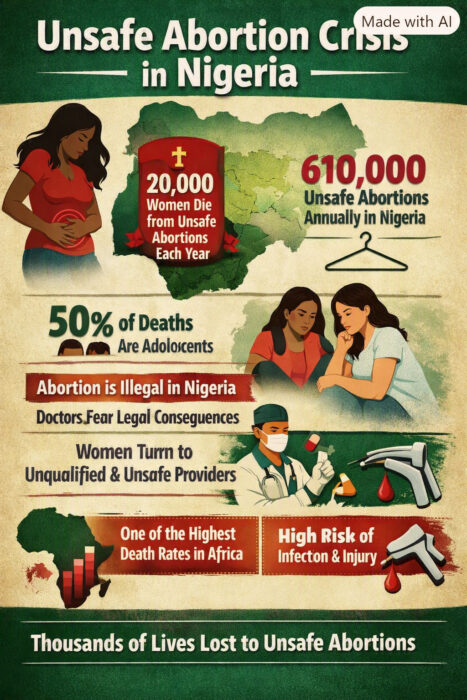
According to a journal article, “Unsafe abortions cause 20 000 deaths a year in Nigeria,’ by the National Library of Science, “The Society of Gynaecologists and Obstetricians of Nigeria estimates that about 20,000 Nigerian women die from unsafe abortions each year.”
The report further explains that the figure comes from studies conducted by the society and Nigeria’s Federal Ministry of Health.
The report also states: “The estimate also aligns with the findings of a nationwide survey conducted by Friday Okonofua, Dean of the School of Medicine at the University of Benin and Executive Director of the Women’s Health and Action Research Centre in Nigeria.
“The survey found that an estimated 610,000 unsafe abortions are carried out in Nigeria annually and that about half of the 20,000 women who die from complications arising from unsafe abortions are adolescents. The death rate from unsafe abortions in Nigeria is believed to be among the highest in Africa.
“Abortion is illegal in Nigeria except under very limited circumstances, and many medical practitioners decline to perform the procedure because of the potential legal consequences.
“As a result, many women seeking abortions turn to unqualified providers who offer quick and inexpensive procedures, often with fatal consequences.”
This report was facilitated by Women Advocate Research and Documentation Centre (WARDC) as part of the Memorial Campaign on Ending Preventable Deaths from Unsafe Abortion in Lagos State. Series 1
#WARDC
#unsafeabortion
#LagosState
#STOPGUIDELINE