

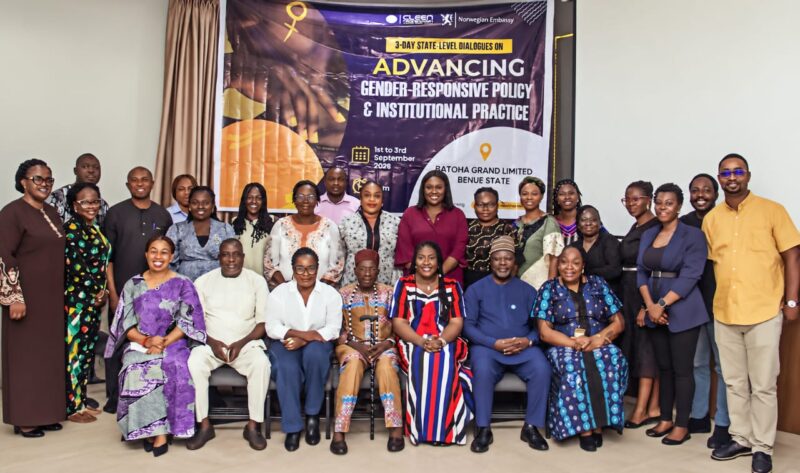

A new round of state-level policy dialogues will bring together government officials, security and justice actors, traditional leaders, civil society, and women-led organisations across five Nigerian states, in a push to move gender-responsive governance from paper commitments to institutional practice.
The dialogues scheduled for Nasarawa, Benue and Imo States from September 1–3, and for Plateau and Kaduna States from September 8–10 are being organised in response to what implementers describe as a persistent gap between Nigeria’s gender policy architecture and what happens inside state institutions.
“Nigeria has no shortage of gender frameworks; what we don’t have consistently is implementation,” said the programme’s state coordinator, describing the rationale behind the initiative.
“The question we are asking in every state is simple: what was promised, what has actually been done, and what is standing in the way.”
Nigeria has built out a wide-ranging legal and policy framework on gender equality over the past two decades, including the National Gender Policy, the National Action Plan on Women, Peace and Security, the Violence Against Persons (Prohibition) Act and the Child Rights Act.
But organisers say these commitments have not consistently translated into institutional budgets, operational guidelines or measurable outcomes for women and girls.
“Gender considerations are still not systematically built into planning, budgeting or procurement in a lot of MDAs,” a Ministry of Women Affairs official said, describing gaps that the dialogues are designed to surface. “Without that, a policy stays a document on a shelf.”
The challenge is sharper in conflict-affected states. Kaduna, Plateau, Benue and parts of Nasarawa continue to grapple with insecurity and displacement that disproportionately expose women and girls to gender-based violence and barriers to justice, while Imo’s gender agenda is shaped by insecurity, youth vulnerability and economic pressure, according to organisers.
Unlike typical one-day awareness events, the dialogues are structured around four guiding questions in each state: What commitments already exist? What is being implemented? Where are the institutional gaps? And what practical action can close them?
“We are deliberately avoiding the conference format,” one facilitator involved in the design said. “Evidence presentation, institutional reflection, sector breakout sessions all of it is built to end in a set of state-specific commitments, not a communiqué that gets filed away.”
Each state dialogue is expected to draw around 40 stakeholders, including representatives from Ministries of Women Affairs, Justice, Budget and Planning, and Finance; state Houses of Assembly; the Nigeria Police Force; the Nigeria Security and Civil Defence Corps; the Department of State Services; correctional institutions; the Legal Aid Council; 20 women mediators; and members of the media.
On the first day in each state, teams are expected to visit high-impact institutions including Governors’ Wives’ Offices, State Houses of Assembly, Ministries of Women Affairs and Justice, and state security leadership to press for direct institutional ownership of recommendations.
“Ownership can’t happen at the end of a workshop,” a participating civil society representative said. “It has to happen in the same room as the people who control the budget line.”
The initiative is expected to produce five State Gender Policy and Institutional Practice Dialogue reports, five State Gender-Responsive Governance Action Matrices, and a consolidated Cross-State Policy and Practice Synthesis Report.
Organisers say success will be measured less by attendance and more by whether states begin integrating gender considerations into planning and budgeting, strengthen coordination among gender, security, and justice institutions, and use gender-disaggregated data more in decision-making.
“We’ll know this worked if, a year from now, the recommendations show up in a budget line, not just in a report,” the state coordinator said.


