
By Juliana Francis
Unsafe abortions continue to pose grave risks to women and girls, often leaving survivors with lifelong complications.
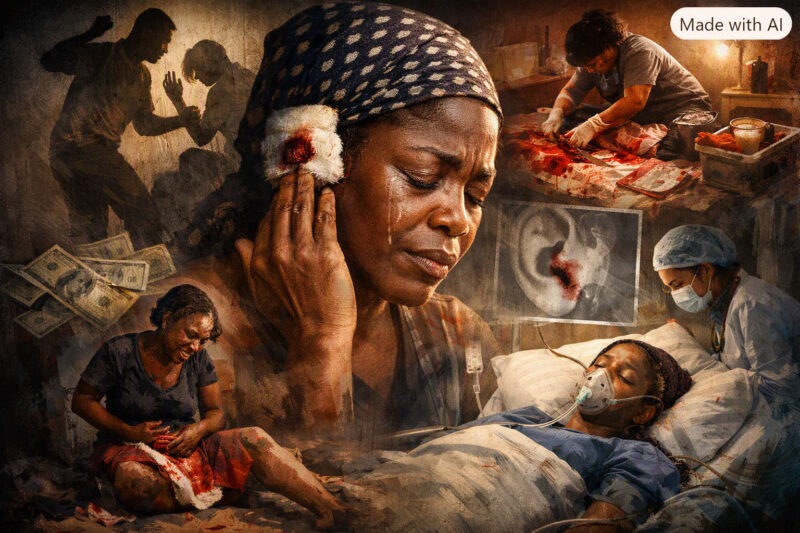
One such case is that of 48-year-old Adanne, a mother of seven, who now lives with permanent hearing impairment after a near-fatal abortion attempt.
Speaking in the LASU/Igando area of Alimosho Local Government, Adanne recounted her ordeal as a stark warning against unsafe abortion practices. She explained that years of domestic abuse and financial hardship pushed her into terminating multiple pregnancies.
Her most harrowing experience occurred when a midwife performed an abortion in her apartment. Initially, the procedure seemed routine, but by midnight she was in excruciating pain and bleeding heavily.
“When I got out of bed, I saw a bloody mass gushing from my body. Later, I was told I was carrying twins and had an incomplete abortion because the second foetus was not properly evacuated,” she recalled.
Adanne was rushed to Ajeromi General Hospital in Ajegunle, where doctors discovered retained pregnancy tissue. Despite treatment, her condition worsened, and she collapsed days later, requiring emergency transfer to Lagos University Teaching Hospital (LUTH).
Although she survived, the ordeal left her with permanent complications.
“When I regained consciousness, I realised I could not hear properly. Even today, I still struggle to hear people clearly,” she said. “Blood was coming from my ears, and the doctors later told me my hearing loss was caused by complications from the abortion.”
Adanne’s story highlights the hidden dangers of unsafe abortion, particularly for women trapped in cycles of abuse and poverty. Health experts warn that unsafe procedures remain a major public health issue in Nigeria, where access to safe reproductive healthcare is limited.
Adanne’s story further emphasised the urgent need for greater awareness, improved access to safe medical services, and stronger protections for women.
The National Library of Medicine confirms that unsafe abortion in Nigeria is a public health concern and an issue of social inequity, calling for efforts to improve equitable access to safe, high-quality and client-centred services.
This report was facilitated by the Women Advocates Research and Documentation Centre (WARDC) as part of the Memorial Campaign on Ending Preventable Deaths from Unsafe Abortion in Lagos State. Series 7