
By Nnamdi Prince
There is a particular kind of quiet that settles over a Nigerian state the morning after a hard-fought election.
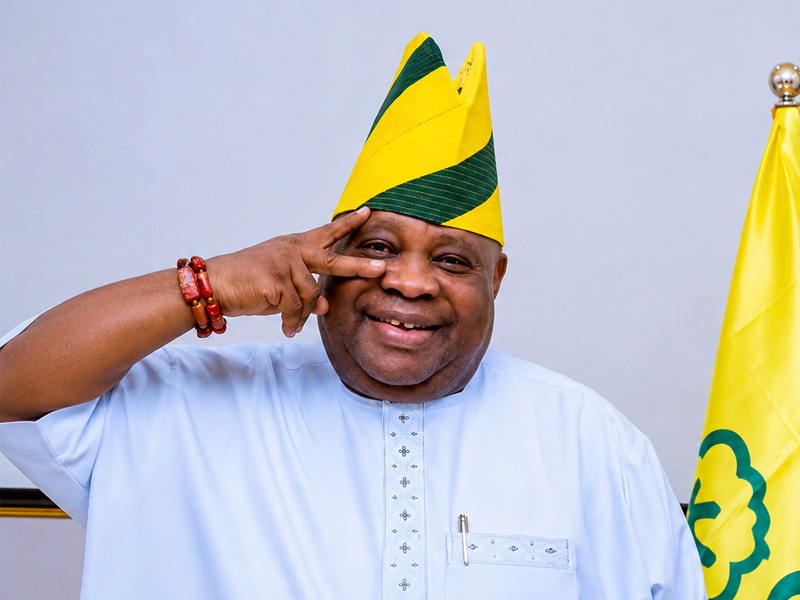
Osun woke to that quiet on Sunday. Governor Ademola Adeleke of the Accord Party had been declared winner of Saturday’s governorship poll, seeing off Bola Oyebamiji of the All Progressives Congress by a margin of just over 66,000 votes and carrying 19 of the state’s 30 local government areas. For Adeleke and his party, it was history: the Accord Party’s first governorship victory in Nigeria. For everyone else who watched the weeks leading up to it, the quiet was less a relief than a pause; the kind that follows a storm rather than the kind that precedes calm.
Because the story of Osun 2026 was never really about who won. It was about what the state, and the country watching it, was prepared to tolerate to get there.
Start with the rhetoric. In the days before the vote, a video began circulating of Senator Francis Fadahunsi, the APC lawmaker for Osun East, addressing a crowd outside a traditional ruler’s palace in Ilesa. In it, he appeared to instruct supporters to attack Accord Party members found in the area before election day.
The Osun State government considered the remarks serious enough to go to court, asking that the police be compelled to investigate rather than wait for violence to materialise before acting. The senator’s camp offered the now-familiar defence: that he meant the language metaphorically, as an exhortation to defeat rivals at the ballot box rather than in the street.
Whatever his intent, the episode captured something bigger than one man’s choice of words. It is a measure of how casually the vocabulary of violence has entered Nigerian electioneering that a sitting senator could be filmed telling supporters to “kill” members of a rival party and the resulting controversy would revolve around interpretation rather than accountability.
He was not, by most accounts, an outlier. Civil society groups tracking the run-up to the poll, including Yiaga Africa and the Kimpact Development Initiative, documented dozens of election-linked violent incidents in the months before voters went to the polls, alongside abductions, clashes between party loyalists and cult groups, and disruptions to the collection of voter cards in areas such as Oriade. Vote buying was reported to be especially open in Ife Central.
Technical failures in the Bimodal Voter Accreditation System surfaced in Ede South and Ilesa East, feeding the usual anxieties about whether glitches are simply glitches. None of this is new to Nigerian elections. What should trouble us is how unremarkable it has become to say so.
Then there was the money. Ten days before voters cast their ballots, the Economic and Financial Crimes Commission obtained a court order freezing the Osun State government’s accounts, over allegations linked to roughly ₦11bn in intervention and ecological funds. On paper, this is precisely the kind of scrutiny a serious anti-corruption agency ought to apply, election or no election.
In practice, the timing did the talking. Freezing a sitting government’s accounts days before it faces the electorate is either a coincidence so poor it borders on institutional carelessness, or it is something else. President Bola Tinubu, facing the backlash, ordered the EFCC back to court to vacate the order, saying he had not been briefed in advance and that nothing should be done to suggest a federal agency was being used to interfere with a state election. That intervention was, in one sense, the right call.
In another, it was itself an admission of how easily the machinery of federal law enforcement can be pointed at an inconvenient state government, and how much depends on a president’s willingness, this time, to pull it back.
This is the part of the Osun story that ought to concern anyone thinking about 2027, not just Osogbo. A ruling party’s opponents do not need to be defeated outright if they can be made to fight an election with one hand tied by frozen accounts and a state security apparatus is stretched thin by real and threatened violence. Osun’s government happened to survive the squeeze. Not every opposition-held state will be so fortunate, or so well organised, the next time a similar template is tried.
None of this should obscure what also went right. More than 25,000 security personnel were deployed to protect voters and materials, a number that reflects the scale of the risk taken seriously by the police and by agencies such as the Nigeria Security and Civil Defence Corps.
INEC’s result-viewing portal allowed the count to be watched, ward by ward, in something close to real time, and the final figures were uploaded and declared with a transparency that Nigerian elections have not always managed. Adeleke’s win, whatever one makes of the man or his party, was not manufactured in a back room; it was counted, in public, against a credible opposition that took eleven local government areas of its own.
That is the paradox worth sitting with. Osun delivered an election that was, by the numbers, genuinely competitive and reasonably well administered, and one that was conducted under the shadow of incitement to violence, alleged political killings, and a financial ultimatum against the incumbent government that only a presidential intervention reversed. Nigerians have grown practised at holding both truths at once: the vote counted, and the conditions around it should never have been allowed to get this close to the edge.
The lesson from Osun is not that Nigerian democracy is failing. It is that its safeguards- a free press willing to publish an inflammatory video, a police command willing to summon a senator over it, civil society groups keeping a public tally of violence, a president willing to reverse an ill-timed use of federal power- are doing exactly the work they were built to do, and doing it under more strain than they should have to bear.
The question Nigeria cannot keep deferring is what happens in a state, or an election, where those safeguards do not hold. Osun was the warning. The remaining opposition states heading into 2027 are the test of whether anyone in Abuja was listening.