
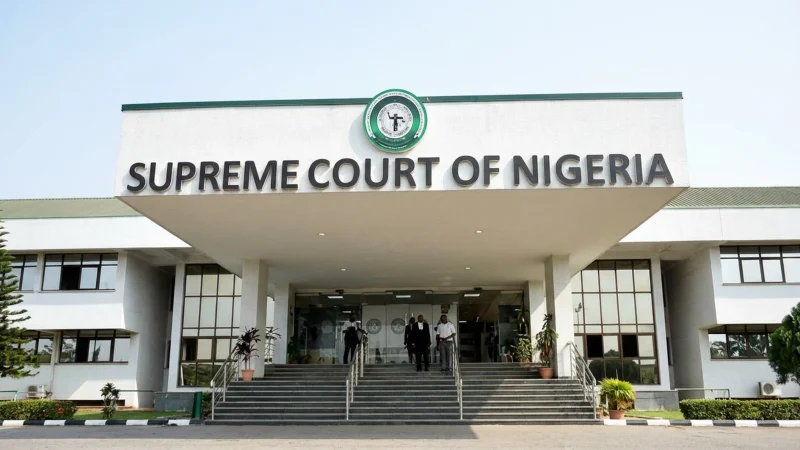

The Supreme Court has partly allowed an appeal in the case of Ibiowotisi v. Agbaje (2026) 1 NWLR (Pt. 2024) 115, delivering a landmark ruling on the requirement to exhaust local remedies in disputes relating to minor chieftaincy titles.
The apex court, in a unanimous judgment, examined whether aggrieved parties must exhaust administrative remedies before approaching the courts and whether the provisions of the Chiefs Law of Ondo State conflict with constitutional provisions on judicial powers.
The dispute arose following the death of Pa Zachaeus Fatimehin Olomodulawe, which created a vacancy in the Olomodulawe Chieftaincy title in Oke-Emo Quarters of Ilawe Ekiti. The 2nd to 4th appellants nominated the 1st appellant for the traditional title.
Dissatisfied with the nomination, the respondents protested, alleging that the 1st appellant was not a member of the Olomodulawe family and that native law and custom were not followed in his appointment. The respondents submitted letters of protest to the 5th appellant, who served as the prescribed authority over the chieftaincy, as well as to the 2nd appellant.
Despite the protests, the 1st appellant was approved and installed as the traditional ruler by the predecessor of the 5th appellant, the Alawe of Ilawe Ekiti. After waiting two years without receiving any response or decision on their petitions, the respondents filed a suit at the trial court, seeking declaratory and injunctive relief.
The trial court struck out the suit, holding that the respondents failed to exhaust remedies under Section 13(4) of the Chiefs Law of Ondo State, which requires aggrieved parties to first seek resolution through administrative channels.
However, the Court of Appeal overturned the trial court’s decision, ruling that the respondents had fulfilled all legal requirements before approaching the court. The appellate court also declared Section 13(4) of the Chiefs Law unconstitutional and proceeded to determine the merits of the case, granting relief in favour of the respondents.
Aggrieved by the appellate court’s decision, the appellants approached the Supreme Court.
Delivering its judgment, the Supreme Court held that while the Chiefs Law requires aggrieved persons in minor chieftaincy disputes to first seek resolution through prescribed administrative procedures, the respondents in this case were justified in approaching the court.
The court noted that Section 13(4) of the Chiefs Law mandates the prescribed authority to determine disputes and notify affected parties of the decision. The apex court found that the 5th appellant failed to perform this duty, leaving the respondents without any decision to challenge or escalate administratively.
The court held that the doctrine of exhaustion of internal remedies applies only where administrative procedures are properly activated. It ruled that the respondents could not be penalised for the inaction of the prescribed authority.
The court stated that since no decision was made by the prescribed authority, the respondents were entitled to seek redress in court.
The Supreme Court further held that Sections 13(4) and (5) of the Chiefs Law do not oust the jurisdiction of the courts and are not unconstitutional. The apex court emphasised that laws requiring parties to explore administrative dispute resolution mechanisms before litigation merely establish procedural conditions and do not conflict with the Constitution.
It consequently set aside the portion of the Court of Appeal judgment which declared the provisions unconstitutional.
The Supreme Court reaffirmed the supremacy of the Constitution and the right of citizens to access the courts, stressing that statutory provisions requiring administrative remedies must not be used to frustrate access to justice.
The court also clarified that failure to comply with statutory preconditions may suspend, but does not permanently remove, the jurisdiction of the courts.
Dr. E.K. Adetifa appeared for the appellants, while A.T. Hassan, alongside Mohammed Kabiru Abdullahi, Ahmed B. Eleburuke, and Vivian C. Udoji, represented the respondents.
The case was researched and edited by Godspower Eroga, Esq., on February 7, 2026.