
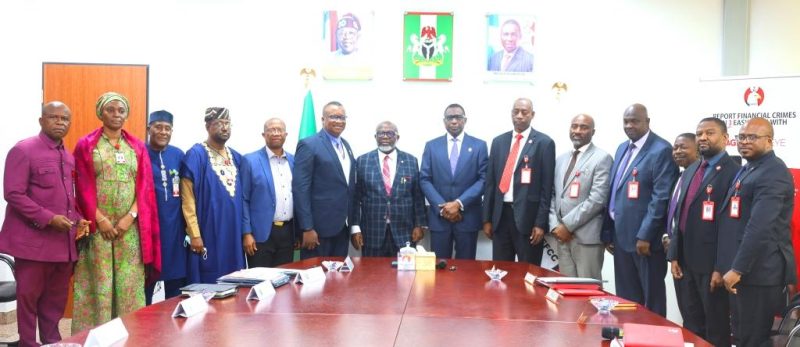

The Executive Chairman of the Economic and Financial Crimes Commission (EFCC), Mr Ola Olukoyede, has identified a systemic disregard for the rule of law as the primary driver behind Nigeria’s persistent struggle with corruption and poverty.
Olukoyede made these remarks on Thursday, February 19, 2026, at the EFCC headquarters in Jabi, Abuja, during the official signing of a Memorandum of Understanding (MoU) with the Fiscal Responsibility Commission (FRC).
Addressing the FRC delegation led by Chairman Victor Chinemerem Muruako, the EFCC boss argued that Nigeria possesses ample resources to thrive but is held back by a “general aversion” to regulations.
He noted that one of the nation’s major challenges remains compliance with laws, asserting that if institutions and citizens reached even an 80% compliance rate, the country’s economic standing would be vastly different.
He further supported this assertion by stating that 80% of public corruption could be eliminated if the sanctity of procurement and contract processes were strictly maintained.
The newly signed MoU aims to move beyond diplomatic gestures by establishing a Joint Investigation Team. This collaboration is designed to sanitise budgetary processes by ensuring transparency in how funds are allocated and spent across Ministries, Departments, and Agencies (MDAs). Furthermore, it seeks to cleanse procurement by targeting loopholes in contract awards and facilitating direct information sharing between the two agencies.
Olukoyede emphasised that the goal is not merely to sign a document but to operationalise it immediately. He noted that a visible partnership would signal to the public that the era of “business as usual” is over, specifically through the EFCC gaining access to FRC oversight reports for immediate action.
The EFCC Chairman also highlighted recent successes, noting that the Financial Action Task Force (FATF) recently delisted Nigeria from its “Grey List.” He attributed this milestone to the rigorous work of anti-corruption agencies in monitoring money laundering and terrorist financing, promising that the commission is prepared to intensify these efforts further.
Responding to the charge, FRC Chairman Victor Muruako praised the EFCC’s “superlative performance” under Olukoyede’s leadership. He expressed optimism that the formal partnership would provide the necessary muscle for the FRC to fulfil its regulatory mandate.
Muruako concluded by stating that the MoU would empower both commissions to work one-on-one to ensure that the “hydra-headed element” of corruption is finally addressed.