
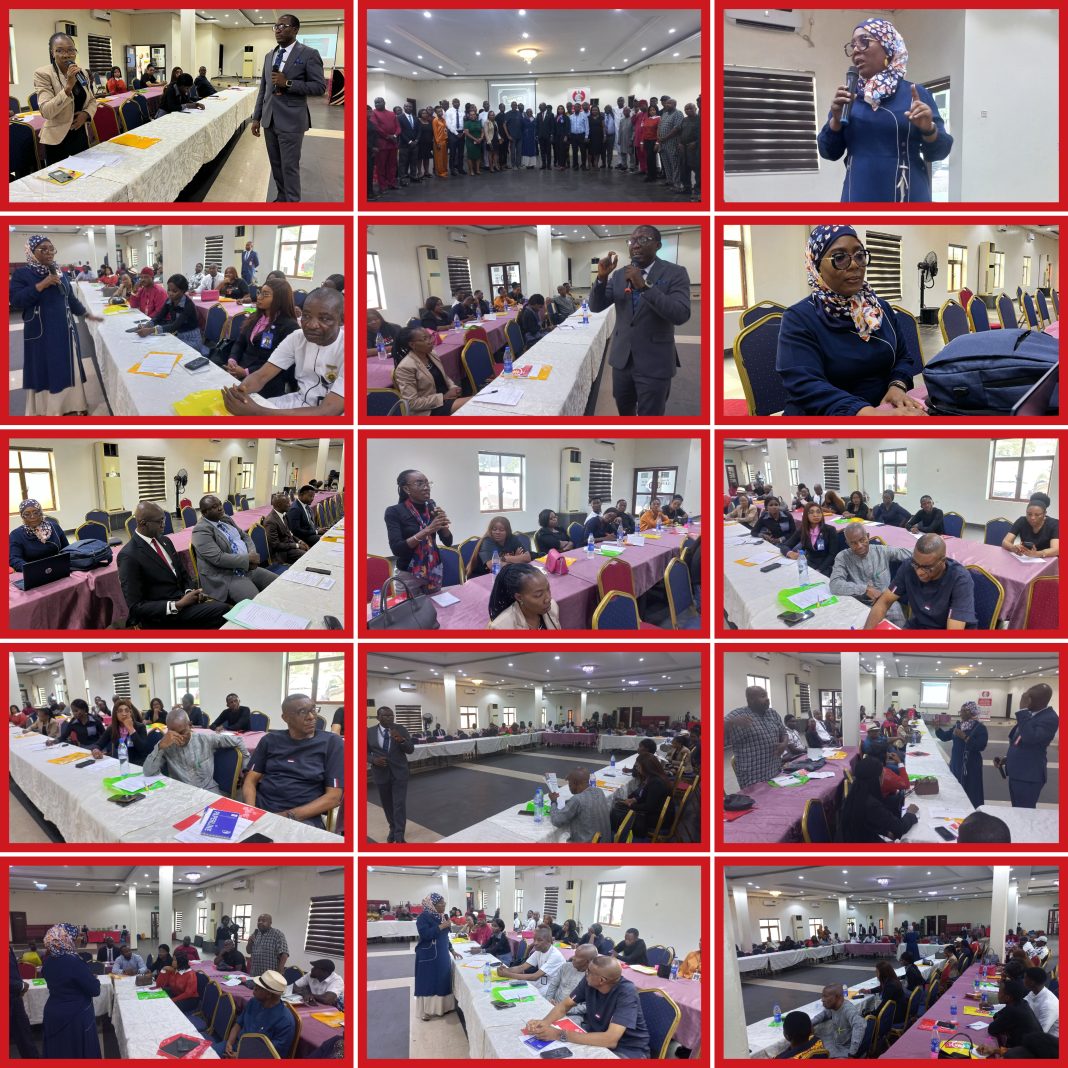

The Economic and Financial Crimes Commission, EFCC, has charged Designated Non-Financial Businesses and Professions, DNFBPs, across the country to carry out their businesses in line with the provisions of the Money Laundering (Prohibition and Prevention) Act, 2022.
The charge was given on Thursday, February 27, 2025 in Enugu during a one-day sensitization programme, organized by the Special Control Unit against Money Laundering, SCUML, for DNFBPs in the South-East.
Speaking on the theme, “From Awareness to Action: Mobilizing DNFBPs for Compliance”, Head, Strategic Analysis and Cooperation, SCUML, Assistant Commander of the EFCC, ACE I Korede Abdul-Aziz, described Know Your Customer, KYC as a process aimed at verifying the identity of clients to prevent fraud and money laundering while Customer Due Diligence, CDD is a critical park of KYC, involving the assessment of clients to identify and mitigate potential risks, related to money laundering and financial financing.
She said that the application of KYC and CDD are key measures to prevent money laundering especially by politically exposed persons, PEPs.
“One of the pillars for strong and effective anti-money laundering programmes is the adoption and implementation of comprehensive Customer Due Diligence policies and procedures that are applicable to all customers, particularly those that present a higher money laundering risk like the PEPs. CDD programmes enable you to establish the identity of customers and predict the types of transactions in which the customer is likely to engage”, she said.
Abdul-Aziz outlined levels of due diligence which include, Enhanced Due Diligence, Customer Due Diligence and Simplified Due Diligence. She enjoined the participants to establish a programme that will regularly monitor transactions to proactively identify potentially suspicious transactions.
Speaking on Best Practices for DNFBPs, Abdul-Aziz said, “Regularly train your staff on KYC and CDD processes and the importance of PEP recognition and reporting obligation; stay updated on regulatory changes, establish clear reporting channel; collaborate with regulatory agencies and implement robust KYC and CDD procedures”. She thereafter outlined the consequences and penalties for not complying with the Money Laundering (Prohibition and Prevention) Act, 2022 which include; monetary fines, license suspension, mandatory compliance training and regular audit.
Abdul-Aziz also discussed Targeted Financial Sanctions on Terrorism Financing, and Proliferation Financing wherein she described TFS as sanctions imposed against specific individuals, groups or organizations in order to stop them from disrupting international peace and security, and also from financing proliferation of weapons of mass destruction.
“As a preventive measure, you are meant to undertake daily checks on the database to identify possible matches with names on the Sanctioned Lists issued by the UN or the Nigerian Sanctioned List. Where a positive match is made with a sanctioned individual, you are required to freeze all funds, without delay and without prior notice to the listed individual or prohibit making funds available or rendering financial services to the person”, she said.
Speaking on Identifying and Reporting Suspicious Transaction Reports, ACE II Promise Oluigbo, Head SCUML in Enugu Zonal Directorate, said “suspicious transaction is where a transaction involves a frequency which is unjustifiable or unreasonable, where it is surrounded by conditions of unusual or unjustified complexity or where it appears to have no economic justification or lawful objective”.
He called for effective monitoring of unusual transactions, adding that for the monitoring system to be effective, the scope and complexity of the monitoring process should be determined on a risk-sensitive basis. “The better the reporting entities know their customers, the greater will be their ability to identify discrepancies between a given transaction and the customer’s risk profile, this in turn will provide the reporting entities with crucial information to assess whether unusual or suspicious activities exist”.
He thereafter outlined how to make Suspicious Transaction Reports and what information to report.
Oluigbo also discussed Implementing Administrative Sanction Guidelines for DNFBPs where he outlined types of sanctions which include, fines, under monetary sanctions and suspension, revocation or withdrawal of license and warning letters, under non-monetary sanctions.
Earlier in his opening remarks, the Acting Zonal Director of the EFCC, Enugu Zonal Directorate, Deputy Commander of the EFCC, DCE Onjefu Obe called on the DNFBPs to strengthen compliance with the regulatory frameworks that have been established by the SCUML.
The training, which was focused on creating awareness for the DNFBPs, had massive turnouts of participants.