
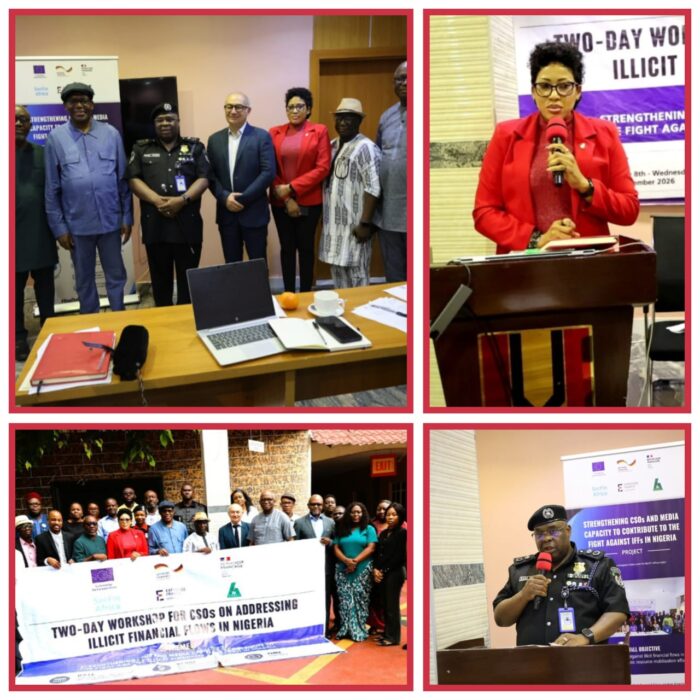

The Executive Chairman of the Economic and Financial Crimes Commission, EFCC, Mr Ola Olukoyede, has called on Civil Society Organisations (CSOs) across the country to redouble their efforts in offering support to the EFCC in its fight against Illicit Financial Flows.
He made the call in Uyo at a two-day workshop organised by the Africa Network for Environment and Economic Justice (ANEEJ) under its SecFin Africa Project, with the theme “Strengthening CSOs and Media Capacity to Contribute to the Fight against Illicit Financial Flows (IFFs) in Nigeria”. The event drew participants from various CSOs.
The EFCC’s boss decried the damaging impact of IFFs, stressing that they stall development, destroy public trust and cast a slur on governance. He noted that CSOs have important roles to play through advocacy, investigative reporting and public awareness. He further emphasised that the fight against financial crimes requires collaboration among law enforcement agencies, government institutions, CSOs, and the media.
Olukoyede, who spoke through the Head of the Public Affairs Department, ACE II TE Nwosu, assured both the organisers and participants that the EFCC remained resolute in its mandate to investigate, prevent, and prosecute financial crimes.
He then called on CSOs to continue raising public awareness, promoting transparency, and strengthening the integrity of the financial system for a better, more prosperous Nigeria.
Earlier, the Executive Director of ANEEJ, Rev. David Ugolor, in his welcome address, stated that IFFs pose a serious threat to Nigeria’s economic stability and development. He identified corruption, money laundering, procurement fraud, tax evasion, trade misinvoicing, and profit shifting as practices that contribute to illicit financial flows. He called for stronger collaboration among government institutions, security agencies, and CSOs to promote transparency and accountability.
The Akwa Ibom State Commissioner of Police, CP Baba Mohammed Azare, gave a comprehensive breakdown of what constitutes IFFs and the threat it poses to our collective development. He also gave clarity on how to identify these crimes, prevent them and made some recommendations.
Speaking further, Azare explained that “illicit financial flows constitute a major obstacle to economic development, economic governance, and social development in many countries, including Nigeria. They are monies or assets that are illegally acquired, transferred, concealed or utilised. They may arise from corruption, fraud, organised crime, tax-related abuses, smuggling, trafficking, cybercrimes, money laundering, and other illegal activities, and the consequences are far-reaching. These are monies that would have been used to build schools, hospitals, and developmental projects”
Prof. Abdullahi Shehu, SecFin Africa Project Representative, gave a presentation titled “Understanding Illicit Financial Flows in Nigeria: Concepts, Typologies and Development Impact.” He discussed the nature, sources, and various typologies of IFFs, stressing that illicit financial flows are not only about the disappearance of money but also the loss of opportunities and resources that could contribute to national development.
Also speaking, Chinédum Odenyi, Head, Legal Operations Division, Nigeria Financial Intelligence Unit (NFIU), discussed the NFIU’s functions and key mandate, including its role in financial intelligence and combating money laundering and other financial crimes.