

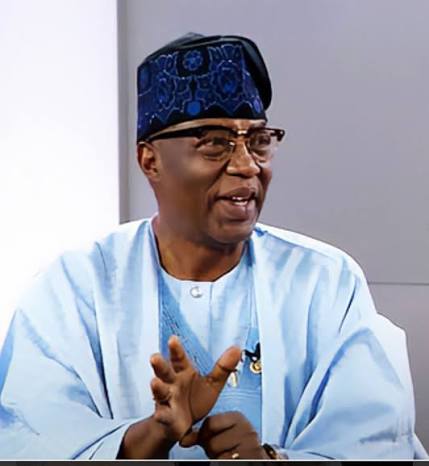

Former Ogun State Governor, Senator Gbenga Daniel, has warned that Nigeria cannot achieve sustainable economic growth without first tackling insecurity, describing the two issues as fundamentally inseparable.
Daniel made the remarks while speaking at the 7th Freedom Online Yearly Lecture, themed “2027 Elections: Economy, Security and Nigeria’s Future,” where he delivered opening remarks ahead of the main lecture.
“Nigeria cannot have a strong economy without security, and it cannot have lasting security without a strong economy,” he said, describing the relationship between the two as inseparable.
The former governor acknowledged recent improvements in Nigeria’s macroeconomic indicators, noting that the economy grew by about 4% in the second quarter of the year, driven partly by gains in agriculture and services. However, he cautioned that official growth figures do not tell the full story of everyday life for ordinary Nigerians.
“The true test of agricultural progress is not only what appears in GDP; it is what Nigerians experience in their daily lives,” Daniel said, posing a series of questions about whether young people can find work, whether farmers can safely reach their farms, and whether small businesses can survive the costs of power, transport, and financing.
Daniel argued that insecurity should be understood as an economic issue and not merely a matter for the military and police.
He said fear and violence directly undermine productivity across sectors.
“Where farmers are afraid to cultivate their land, food production suffers. Where roads are unsafe, the cost of transporting goods rises. Where businesses spend excessively on protection, their competitiveness declines. And where communities live in fear, investment is discouraged,” he said.
He cited figures showing that more than 7,800 people were reportedly abducted in Nigeria between July 2025 and June 2026, calling the number both a security and an economic statistic.
Highlighting the changing structure of the Nigerian economy, Daniel noted that the non-oil sector accounted for approximately 95.8% of GDP in the second quarter of 2026, pointing to growth in agriculture, manufacturing, technology, construction, financial services, tourism, entertainment, and the digital economy.
“Oil remains important, but Nigeria’s future cannot depend on oil alone,” he said, adding that the task ahead is to convert growth in these sectors into productive jobs, higher incomes, and better living standards, particularly for young people.
Turning to Lagos, Daniel described the state as an example of what is possible when population, enterprise, infrastructure, and opportunity converge.
He said the goal now is to extend similar conditions nationwide.
“Lagos has provided such an environment, and we should all recognise that,” he said, expressing hope that entrepreneurs in cities such as Aba, Kano, Ibadan, Jos, Makurdi, and Maiduguri could one day build with the same confidence as their counterparts in Lagos.
Daniel struck an optimistic tone about the country’s prospects, despite its challenges.
“I remain optimistic about Nigeria not because our challenges are small, but because our capacity is greater than our problems. We have the people, the resources, the markets, and the entrepreneurial spirit,” he said, adding that security, leadership, infrastructure, and discipline were needed to convert that potential into prosperity.