


By Olumuyiwa Adejobi
Not quite long ago, I published an article on the IGP’s style of policing Nigeria with the principles of Public Relations, a combination that is not very common in the Nigerian context, particularly in the policing space.
I have taken time to understudy and understand the leadership style of IGP Tunji Disu: the way he administers the Force, relates with his personnel and engages with members of the public. As a Public Relations Practitioner and a royal prince grounded in our culture and traditions, I am convinced that some of these qualities go beyond the person of Tunji Disu himself.
Perhaps, they are also a reflection of the upbringing he received from his parents.
There is something particularly remarkable about having one’s parents alive and present during one’s tenure as Inspector-General of Police. Whether or not this is unprecedented in the history of the Nigeria Police Force, it is certainly a rare privilege and a blessing.
Could such a privilege have an influence on his character and leadership?
I strongly believe it can.
Those who work closely with the IGP can readily attest to qualities such as his calmness, maturity, accessibility, focus and humility. With my experience in the Force spanning more than two decades, I consider it a special privilege for personnel to have an IGP who remains accessible and operates with such openness.
This is not to suggest that previous IGPs were inaccessible. Far from it. Rather, what appears different today is the deliberate infusion of Public Relations thinking into the leadership and administration of the Force.
The way the IGP connects with personnel, engages the public, recognises exceptional service and allows the Nigeria Police Force to tell its own positive stories demonstrates an understanding that policing is not only about enforcement; it is also about relationships, perception, trust and public confidence.
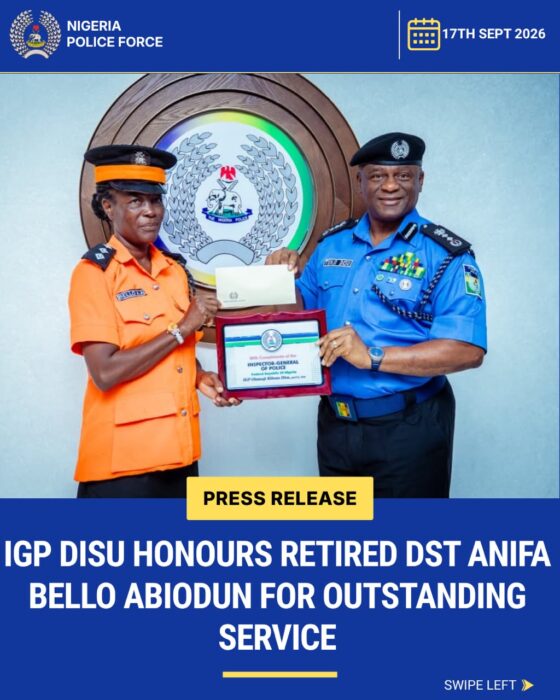
When Nigerians celebrated Anifa, and I wrote a piece in her honour, someone asked in my comment section whether the IGP would also honour her.
I responded that I was confident he would.
I also expressed my belief that the Ogun State Government would recognise her, and that companies and other organisations would likely be interested in her services after retirement because of her professionalism in traffic management and the Omoluabi values she demonstrated.
When the Force Public Relations Department subsequently announced the IGP’s recognition of Anifa, I was not surprised.
I was simply pleased.
And I am always happy whenever the Nigeria Police Force makes the news for the right reasons.
In recent times, positive stories about the Force have increasingly become part of the public conversation. This is important because every positive police story is an opportunity to strengthen public confidence, inspire personnel and reshape the relationship between the Police and the people.
During his recent courtesy visit to the IGP, the President of the Nigerian Institute of Public Relations, Dr. Ike Neliaku, also acknowledged and commended the leadership style of the IGP.
For me, this reinforces a point I have always believed: Public Relations is not merely about publicity. It is a management function. It is about leadership, relationships, communication, reputation and trust.
When these principles are deliberately integrated into policing, the difference becomes visible.
The good work continues.
And good leadership deserves to be acknowledged.
God bless the IGP.
God bless the Nigeria Police Force.
God bless the Federal Republic of Nigeria.
Omooba Olumuyiwa Adejobi, fnipr
Fellow of the Nigerian Institute of Public Relations
Oba Adejobi’s House, Orile-Owu, Osun State, Nigeria


