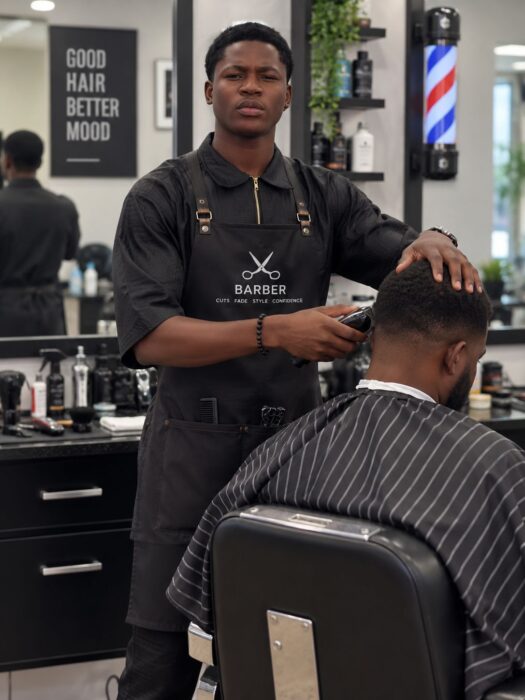

For most people, a haircut is a routine errand. For Jahswill Chiagoziem Asianya, it is the start of a conversation; one that, over the past few years, has grown into a career built on craft, collaboration, and a quiet mission to pass skills on to others.
While most people his age were taking to crime like a duck to water, unsettling local communities and selling fear, Asianya has carved a niche for himself as a hairstylist.
Born on 23 July 2004 in Abakaliki, Ebonyi State, Asianya is a hairstylist and barber whose client list and professional network have expanded steadily as he’s built a reputation for technical range and attentiveness.
His services span cutting, styling, colouring, highlighting, straightening, perming, treatments, shampooing, blow-drying and grooming, but he says the technical work is only ever half the job.
“Every person who sits in my chair comes in with a different story,” he says. “Some want a completely new look. Some are preparing for something important. Some just want a barber they trust. My job is to figure out which one it is before I even pick up the clippers.”
That philosophy shapes how Asianya approaches each client. Before starting any service, he talks through what the person wants, assesses their hair’s condition and texture, and, where needed, suggests alternatives.
“A style can look amazing in a photo and still be wrong for someone’s hair type or lifestyle,” he explains. “I’d rather have that conversation upfront than give someone a cut they can’t maintain and won’t be happy with in a week.”
For Asianya, success isn’t just about how a client looks walking out the door. “I want them to feel like I actually listened to them,” he says. “And I want the style to still make sense for them a month later, not just on the day.”
Grooming trends move quickly, driven in large part by social media, and Asianya has made ongoing learning part of his routine, tracking new techniques, products and styles from barbers and stylists both in Nigeria and abroad.
“What’s popular today might not be what people are asking for in six months,” he says. “I don’t want to be the barber who’s still doing what worked three years ago. I study what other professionals are doing, but I try to understand why something works, not just copy it.”
That habit, he says, is less about chasing trends and more about being ready. “You never know what a client is going to walk in and ask for. I’d rather already know something about it than be learning it in the chair.”
According to him, much of his growth comes through working alongside other professionals rather than in isolation.
He has collaborated with hair brands and stylists including Lush and Ebony, exchanging techniques and gaining exposure to different approaches to hair care.
“I don’t see other stylists as competition,” he says. “Every time I’ve worked with someone else, a brand, another barber, I’ve picked up something I didn’t know before. That’s worth more than trying to guard what you know.”
Perhaps the most distinctive part of Asianya’s work happens outside his own shop.
As a facilitator, he has taken part in community and non-profit programmes that train young people, widows and others in basic hairstyling and barbering skills that can generate income without the heavy start-up costs of many other trades.
“A lot of the people I’ve trained just needed a starting point,” he says. “Some were young people who didn’t know what direction to take. Some were women trying to support their families. I’m not promising anyone instant success; I’m just giving them something practical they can build on.”
He describes the training room as an extension of the same work he does behind the chair. “Whether it’s a client or someone I’m training, it comes down to the same thing: giving someone something that actually changes their situation, even a little.”
Graduates of such programmes, he notes, have gone on to start home-based services, join barbershops, find employment, or pursue further training.
Asianya is quick to point out that a good haircut is rarely just about following what’s popular. Face shape, hair condition, maintenance habits, occupation, and personal taste all factor into what he recommends.
“The goal isn’t to force a trend onto someone because it looks good online,” he says. “It’s to understand what makes that trend work, and then figure out if this actually works for this or that person.”
At 22, Asianya is early in a career he hopes will keep expanding along three fronts: refining his craft, staying current with an industry that never stops changing, and continuing to train others.
“I don’t want to just stay relevant; I want to keep getting better, and I want to keep creating chances for other people to learn,” he says. “All you really need to start is a pair of clippers, some scissors and someone willing to teach you how to use them. That’s basically where I started.”