
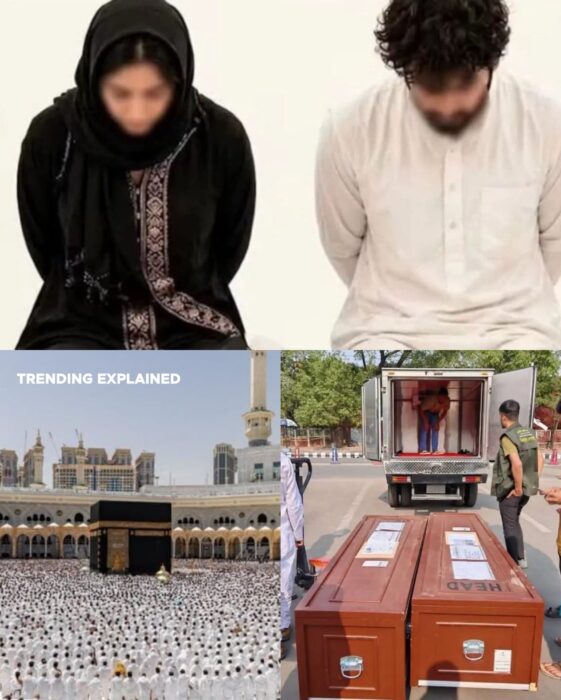

The reported execution of two Bangladeshi nationals by Saudi Arabian authorities over an alleged indecent act inside a mosque in Mecca has sparked widespread debate on social media, with users questioning the severity of the punishment, religious authority and the protection of human rights.
The two individuals were identified in social media posts as Nazrul Islam Abdul Basir and Siri Akhtar, although another post referring to a statement attributed to the Saudi Ministry of Interior gave the woman’s name as Siti Akhtar.
According to a post by Trending Explained, the pair were allegedly executed after being convicted of an immoral sexual act inside a mosque in Mecca.
The post claimed that the alleged act was a kiss on the forehead and that the couple were newlyweds who had travelled to Mecca for their honeymoon.
It further alleged that Saudi authorities refused to recognise them as a married couple and that the forehead kiss was an expression of gratitude to Allah for blessing the man with a beautiful bride.
The post also claimed that their bodies had arrived in Bangladesh in two coffins for traditional burial rites.
However, the account of the alleged forehead kiss and honeymoon was disputed by other social media users, including commentators who said the details had not been established by an official Saudi statement.
An Arabic-language post by a user identified as Abdullah Al-Almai argued that the executions followed a formal conviction by a competent court for an act of indecency inside a mosque in Mecca.
According to the post, the Saudi Ministry of Interior stated that the two Bangladeshi nationals had been convicted of committing an act of indecency in the holy city.
The post said security authorities arrested the pair, investigations resulted in formal charges, and a competent court found the charges proven before sentencing them to death under ta’zir, a category of discretionary punishment under Islamic jurisprudence.
It further claimed that the judgment was upheld, a royal order was issued, and the sentences were carried out in the Mecca region on October 14, 2026.
The commentator disputed the social media narrative that the pair were newlyweds executed for sharing a forehead kiss, saying those details did not appear in the official Saudi statement or the court’s findings.
The post maintained that the case concerned an act of indecency in a sacred place and argued that Saudi Arabia had the sovereign right to enforce its laws and Islamic legal provisions.
It added that the final judicial ruling, rather than unverified social media accounts, should remain the primary basis for understanding the case until further details emerge from Bangladeshi authorities or the consulate.
The claims and counterclaims triggered strong reactions, with several users condemning the reported executions and others challenging the information circulating about the circumstances of the case.
A social media user, Karen, writing as @Africa_Dabra, questioned what she saw as inconsistencies in the treatment of people under religious law.
“Men can marry a 9-year-old, but can’t kiss their adult wife on the forehead,” she wrote, describing the situation as “an abomination of a religion.”
Another user, HE WHO DRINKS, writing as @MrOdunfa, asked why, in his view, death sentences appeared to be associated with so many matters under Islam except rape.
“Why is everything about Islam death sentence except rape??” he wrote, before describing Islam as “a very dangerous religion.”
A user identified as Kay, writing as @kayode_william, contrasted the reported punishment with the Christian understanding of salvation and forgiveness.
“Thank God for our Lord Jesus Christ, who brought salvation to the world and to Christianity,” the user wrote.
Kay added that some Christians did not sufficiently appreciate Jesus Christ’s sacrifice before questioning the use of severe punishment in the name of religion.
“How can you, all in the name of religion, inflict such a destructive punishment on two human lives?” the user asked.
The commentator also questioned whether there was room to seek forgiveness for sin, as understood within Christianity, rather than impose what the user considered a devastating punishment.
Another user, KingDubie, writing as @kingdubie_, reacted angrily to the claim that the couple had been executed over a forehead kiss.
“He kissed on her forehead. ‘Immoral act.’ Then you murder both of them in return,” the user wrote, sarcastically referring to the punishment as a “righteous judgment.”
KingDubie also said that discovering that someone was Muslim sometimes caused the user to question that person’s intelligence, a comment that reflected the increasingly hostile tone of some reactions to the story.
The L2 Lounge, whose account is @JamesonLowe3, used the incident to question the basis of international military and political alliances.
“Stories like this one serve as a reminder. Military alliances are not built on cultural commonality, but instead objective practicality,” the user wrote.
The commentator expressed surprise that Saudi Crown Prince Mohammed bin Salman had not intervened, describing the reported circumstances as ironic because the couple were allegedly in Mecca to celebrate their Islamic faith.
Another user, Bharathiyin Bharatham, writing as @bharatha_desam, criticised what the user described as the silence of people who regularly speak out in support of feminism, secularism and liberalism.
The user argued that some people who campaign for those causes also exploit religious fundamentalism to disrupt countries of their choosing.
“So it’s only convenient that left stays mute on this,” the user wrote, accusing those concerned of failing to speak consistently against practices they considered oppressive.
Abraham Kowo, writing as @Abe_Kowo, linked the controversy to Islamic religious movements in northern Nigeria.
“This is the version of Islam that was imported into Northern Nigeria from Saudi Arabia — Wahhabism and Salafism,” the user wrote.
Kowo questioned the reported killing of a couple for displaying affection, adding that the issue was connected to what the user described as resistance by the leader of Burkina Faso.
Chigozie Bashua, writing as @chigoziebashua, questioned whether the same action would have attracted similar consequences if the individuals involved had been American citizens.
“I believe they wouldn’t have done this to American citizens. Anyway, don’t go for honeymoon in Saudi Arabia,” the user wrote, referring to the alleged forehead kiss and the reported death sentence.
Another commentator, Manchu, writing as @Manchu__, said the accounts circulating online were contradictory and required clarification.
“This case doesn’t make sense. The reporting is contradictory,” the user wrote.
Manchu questioned reports that the individuals had a young child in Bangladesh and asked whether either of them had been married before. The user also questioned whether the pair were already working in Saudi Arabia and how they could have been unaware of the rules governing conduct inside a mosque.
The commentator concluded that the details did not add up, while acknowledging Saudi Arabia’s strict approach to conduct within its territory.
Don Zaga, writing as @CollinsZagaa, questioned whether the Quran instructed Muslims to kill a couple for kissing on the forehead.
“Where in Quran did Allah instruct to kill a couple if they kiss on forehead??” the user asked, urging people to distinguish religion from individuals who, in the user’s view, presented themselves as religious authorities while perpetrating violence.
Another user, ignite1818, said the controversy reinforced a personal decision not to visit or live in a Muslim-majority country.
The user said that although they respected the laws and regulations of other countries, some rules were perceived as restrictive of personal freedom and fundamental rights.
“I respect their laws and rules, but I feel some of their rules violate my inalienable rights and are kinda too restrictive in expressing my freedom, hence why I will never make it a destination,” the user wrote.
Turki Al-Dubian, writing as @Turkialld, directly challenged the allegation that the two individuals had been executed for a forehead kiss.
“This story is false and the footage has no connection to the case,” the user wrote, describing the claim as a distortion of the circumstances surrounding the executions.
The commentator said the case involved an alleged indecent sexual act inside a mosque in Mecca, arguing that sexual misconduct in a place regarded as sacred in Islam was treated as a serious offence.
The user urged people to stop circulating what was described as fabricated information for online engagement.
Bàbátúndé Johnson, writing as @btunddej, criticised those attempting to justify the reported executions through appeals to Sharia.
“Look at these people trying to justify the killing of two young people in the name of Sharia,” the user wrote.
Johnson argued that religious doctrine should not be used to silence questions about the use of violence or to define the cultural identity of the Yoruba people.
“We are Yoruba, not Arabs. Our identity, culture, and heritage existed long before foreign religions arrived on our shores,” the user wrote, adding that people had the right to question religious practices used to justify violence.
The commentator maintained that no religious doctrine should place human life beyond the protection of justice.
“No religious doctrine should place human life beyond the protection of justice, and no appeal to Sharia should be used to silence legitimate questions about the killing of two young people,” Johnson wrote.
Chukwudi Kingsley, writing as @chukwudikings17, responded by sharing a passage from Matthew 11:28–30 in the Bible, which invites those who are weary and burdened to come to Jesus Christ for rest and describes his yoke as easy and his burden as light.
Another user, Toornie, writing as @toornie, expressed disbelief at the idea that a person could face execution for showing affection to a spouse inside a place of worship.
“Expressing my love and compassion inside the church by kissing my wife’s forehead and thanking God for the gift of a wife shouldn’t warrant me getting beheaded,” the user wrote.
Toornie argued that claims of being a religion of peace should be reflected in conduct rather than repeated slogans.
“‘We are a religion of peace’ isn’t by shouting it at every opportunity; it’s self-proclaimed through your practices and behaviours, and people can decipher what peace looks like without being cajoled,” the user added.
Social media commentator Daniel Regha, writing as @DanielRegha, offered a more cautious assessment of the reports while condemning the punishment.
“The reason for their execution wasn’t disclosed by the Saudi Arabian authorities, so the alleged kissing is misinformation,” Regha wrote.
However, he added that the uncertainty surrounding the allegations did not justify the executions.
“But it doesn’t justify the execution. The punishment is extreme and unacceptable,” he wrote.
Abhijit Biswas, writing as @Abhijit88906253, used the controversy to reflect more broadly on religious authority, obedience and humanity.
Biswas recalled attending a seminar several years earlier where a professor compared vision to the head of a turtle and protection to its shell.
The professor, according to the user, had explained that the shell protects the head while allowing the turtle to explore new places, experience new things and improve its chances of enjoying life.
Biswas said the professor had warned that people sometimes retreat into their shells, leaving compliance as the only thing that matters.
The user argued that unquestioning compliance could become the central purpose of life, preventing people from questioning authority or seeking new experiences.
Biswas further criticised what the user described as the influence of self-appointed religious figures and institutions that dictate what people should eat, wear, pray for and how they should conduct their lives.
The commentator questioned why some religious leaders appeared to focus heavily on rules governing personal behaviour while failing to speak out against broader human suffering.
“Where are the godmen when jungles are cut down, and rivers are mined? When drinking water turns yellow? When bombs are dropped from the air, and innocent people are killed? When rape is committed in the name of God?” Biswas asked.
The user also questioned the apparent silence of religious authorities when powerful individuals were involved in wrongdoing, poor people were deprived of their rights, or courts allegedly favoured the wealthy and privileged.
Biswas asked whether religious figures and the institutions they represent could sometimes serve the interests of the state by helping to control people’s minds and maintain existing power structures.
The commentator argued that religion should ultimately help humanity coexist peacefully, but suggested that religious institutions were failing to fulfil that purpose.
“The whole purpose of God was to help us find a way to coexist, to live together,” Biswas wrote, adding that religious institutions appeared to have forgotten what the user considered the true purpose of faith.
Turning back to the case in Saudi Arabia, Biswas said the authorities had reportedly executed two Bangladeshi nationals for what they described as indecent acts inside a mosque, while the full details of the case remained unavailable in the social media accounts under discussion.
“But when people are killed in the name of protecting religion, I have to ask, is this the purpose of God?” the user wrote.
Biswas observed that humanity had made considerable technological and scientific progress, including the ability to explore the depths of the ocean and the vastness of the universe, but had yet to fully understand the importance of compassion and human dignity.
“These two fellow humans would never come back,” the user wrote, concluding with a call for humanity to do better.
The controversy has highlighted the tension between religious law, the sanctity of places of worship, the right to question state punishment and the responsibility of social media users to distinguish verified information from unsubstantiated claims.
While several commentators condemned the reported executions as disproportionate and unacceptable, others insisted that the allegation of a forehead kiss had not been established by the official account cited in the online debate.