

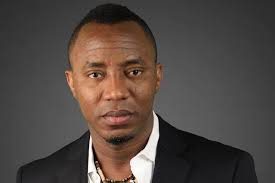

As Nigeria prepares to commemorate June 12 Democracy Day on Friday, human rights activist and former presidential candidate, Omoyele Sowore, has reflected on his encounters with the late Chief Moshood Kashimawo Olawale (MKO) Abiola, the widely acclaimed winner of the annulled June 12, 1993, presidential election.
In a post shared on his social media platform on Monday, Sowore recounted four significant moments in which he crossed paths with the late businessman, politician, and philanthropist.
According to Sowore, the first and most memorable encounter occurred during a media interview, when he stood behind Abiola alongside the late elder statesman, Chief Anthony Enahoro, as Channels Television founder John Momoh interviewed the politician.
“I met Chief MKO Abiola four times,” Sowore wrote. “One of those encounters was at very close range the day I stood behind him alongside the late Chief Anthony Enahoro while Channels Television founder John Momoh interviewed him.”
He said the second encounter took place on November 10, 1993, shortly after a court ruling that declared the Interim National Government led by Chief Ernest Shonekan illegal.
Sowore recalled that after returning from court, where Justice Dolapo Akinsanya delivered the landmark judgment, he climbed over Abiola’s fence to speak with him and cautioned him about some individuals within his inner circle.
“The second time was on November 10, 1993, after we returned from court, where Justice Dolapo Akinsanya had declared the Interim National Government of Chief Ernest Shonekan illegal. I climbed over Abiola’s fence and spoke with him from the other side, warning him once again about some of the people around him,” he stated.
He added that he wished the footage of the encounter had been preserved for historical records.
The activist said his third encounter with Abiola occurred when the politician returned to Nigeria from a brief exile aboard an Air France flight.
Although he could not get close to him at the airport, Sowore said he mobilised many students to welcome him back to Lagos.
The fourth and final encounter came under sombre circumstances at Abiola’s burial following his death in detention in 1998.
“He was brought home dead. It was our last meeting,” Sowore said.
Reflecting further on their interactions, Sowore noted that only the first encounter qualified as a true meeting in the fullest sense.
He revealed that during that meeting, Abiola offered him a substantial amount of money, which he declined.
“Chief Abiola saw me, offered me a huge wad of cash, which I respectfully rejected, and I warned him about the sycophants and opportunists surrounding him,” Sowore wrote.
He maintained that while the other three encounters were significant moments in his life, they did not constitute meetings of the same nature as the first.
Abiola remains a central figure in Nigeria’s democratic history, with June 12 officially recognised as Democracy Day in honour of the annulled 1993 presidential election, widely regarded as one of the freest and fairest elections ever conducted in the country.


