

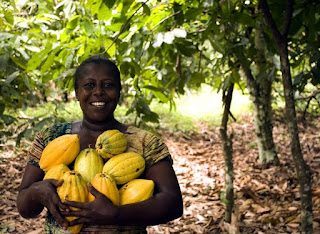

In this concluding part of the stirring story of women cocoa farmers, a cocoa merchant reveals to Juliana Francis how these farmers contribute to the socio-economic boost in Nigeria.
One of the merchants who used to buy from the women is Mr Victor Agosile. He has been a cocoa merchant for 22 years. He sells his cocoa to local firms and also exports it. Agosile explains that the process of the whole drama starts with the cocoa farmers. “Cocoa is planted for five years before it gets to the maturity stage.
When it gets to the maturity stage, it will require some chemicals to be sprayed on it to be free from insects that could damage the seeds. The spraying is done every four weeks, but it all depends on the level of rain. If the rain is too high, we reduce spraying to three weeks or thereabout. “We equally have agents, who we use to give money, to contact these farmers.
These agents go to their farms. The agents then bring the cocoa to us. We send it to the final exporter. These women are creating more employment because it helps the Nigerian foreign exchange, too. Cadbury and Nestle also buy these cocoa seeds,” he says. Agosile explains that to get cocoa to the importers, it has to go through a process called ‘Cocoa kick.’
This is when the cocoa is crushed to a certain level, and the shells are removed. The seeds will then be crushed into powder. The powdered substance is the one that will be exported. He discloses that firms abroad use it to make chocolate. There have been rumours that all the cash crops in Nigeria are gone, compelling Nigeria to focus and rely on crude oil, but Agosile says cocoa is still very much in Nigeria. He adds, “The truth is that our government is not paying adequate attention to it. The world consumption of cocoa is about five million tons.
ALSO READ: The Amazons of cocoa farms
West Africa produces about 75 per cent of it. Ivory Coast is the leading producer in the world. Out of five million tons, the Ivory Coast alone produces about two million tons, followed by Ghana, which produces about 850 tons, and Nigeria is the third. We produce just about the range of 450 to 500 tons. And this town (Idanre) is the highest producer of cocoa in Nigeria. “Ondo State generally produces tons of cocoa.
Of these tons produced by Ondo State, this town alone (Idanre) produces more than any other town. After Ondo State, we talk about Cross River State. We have about seven states in Nigeria that produce cocoa. We also have Ekiti, Osun and Edo states. Those are the major producing cocoa states in Nigeria.” Agosile says the impact of women in cocoa production is immense because they play a vital role in nation-building and employment.
“They follow their husbands to the farms during the planting of cocoa; they even joined in all things before it gets to the maturity stage. “Cocoa is nursed for about five years. After those five years, we will have a complete farmland which will later be given to Alagbase to manage for the farmer.
In that exercise, women contribute a lot. A lot of them have their own cocoa plantations. Many of them in this town have more plantations than the men. Some of them pay their children’s school fees alone.” The cocoa merchant says that in his 22 years in the business, he has found out that between female and male cocoa farmers, the women are often more sincere in their dealings. Agosile says he prefers dealing with female farmers, not just because of their sincerity, but also because of their compassionate nature. Although we cannot do without the men, too, because they are the major players in the cocoa business, a lot of women have joined the cocoa business.
Some of the women build houses with this cocoa business, and some use cars. There is a woman who produces cocoa that is worth about N6 million per annum. Women are good managers.” Speaking on areas in which the government can help to boost cocoa farming, Agosile, like Esther, says that fixing the roads is essential.
He says if essential things, like good roads and infrastructure, are looked into, including power supply, younger folks will be engaged in cocoa farming. The merchant adds that the government just needs to bring urbanisation to the villages.
He says, “This will encourage the youth to be able to stay in a local area, but most of all, these facilities are lacking, and the stress of going to the farm is not encouraging.
“I must be frank with you; it is only agriculture that can create employment in this country. Like now, before cocoa gets to the maturity stage, the farmer first of all plants plantain and in nine months she will have started harvesting it and already making money within that year. The government can also encourage youths by giving them soft loans to kick-start cocoa farming.
The loan of single single-digit, like nine per cent downwards, and the government is doing it on paper, but it is not getting to the grassroots. A businessman will collect the loan to transact his business instead of getting it to the grassroots, for whom the loan is really meant. The real people who need the money can bring about an increase in the production of cocoa.
What cocoa is generating for Nigeria, I think, is not more than number three or four after petroleum. Let’s say cocoa is the fifth on the list of things that are generating money for Nigeria. We can improve on it. If the government can create an enabling environment for farmers, it will increase the incentive to join farming.
If the government can provide good housing, roads and even electricity, youths will be encouraged to become farmers, and it will also enhance cocoa production.” The reporter tried to speak with the state Commissioner for Agriculture, Mr Gboyega Adefarati, but learnt he had resigned his position a few weeks earlier.
The state Commissioner for Information and Orientation, Mr Yemi Olowolabi, who speaks on the matter, describes Idanre as “the home of cocoa farming.” According to him, people in Ondo State just don’t trade; they export, especially under the leadership of the present administration of Governor Rotimi Akeredolu. He says the present administration has made the cocoa revolution its major focus.
“The governor is targeting young farmers. All those in charge of plantations today are old men and women who either inherited or planted. Now, the government believes that the cocoa revolution is the key to economic restoration, which is why new seedlings were brought and distributed. This will tell you the importance of cocoa in Ondo State.
In fact, very soon, President Muhammadu Buhari will be coming to Ondo State to launch the revolution of cocoa business transformation,” Olowolabi explains. The commissioner says that in Ondo State, nobody cares whether the farmer is male or female.
“We have female and male cocoa farmers, but more of men; most of the women who are into cocoa farming inherited or planted it, but cocoa is a big business here,” Olowolabi says that the cocoa plantations have given impetus to the consideration of building companies in the state.
“There are two major cocoa-based industrial efforts at Ile-Oluji. At Ile-Oluji, we have Ile-Oluji Cocoa Industry, where the best nutritious cocoa tea is produced, and in Idanre, we have a chocolate factory, which is about to kick off,” he adds.
The Corporate Affairs, Nestle Nigeria, Ms Victoria Uwadoka, says the company sources its raw materials locally, including from Ondo State. She adds that Nestlé has been getting its materials locally for years in Nigeria.
According to her, cocoa from Ondo State meets Nestlé’s international standard because the company doesn’t compromise on standards, especially as a multinational company.
She further says:” We don’t need to import what we know we can get locally in Nigeria, and which is our contribution to the growth of the economy. Also, we have been supporting local producers one way or the other through our various empowerment activities as part of the company’s corporate social responsibility.” She notes that Nestlé is one of the largest producers of beverages in Nigeria.
FIRST PUBLISHED IN THE NEW TELEGRAPH NEWSPAPER IN 2019.