

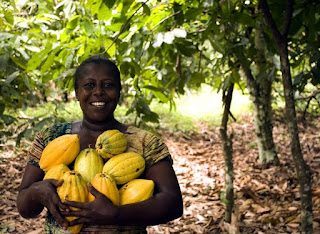

Women brace the odds, lift cocoa farming
Cocoa farming is being revolutionised in Ondo State. Behind the revolution are women, young and old, some are widows. They are gradually taking over from the men, who have traditionally been the farmers. JULIANA FRANCIS, who went to Ondo State, returns with an inspiring story of the female farmers
The sun was beginning to dip behind the ancestral mountains and hills of Sajowa village in Ondo State in preparation for nightfall, when the reporter finally tracked down Cecelia Agbelusi in her home/farm.
She is a cocoa farmer. But she is not alone. There are several other women like her proudly in that field.
An attempt to find these female cocoa farmers during the day is an exercise in futility. It is like looking for the proverbial needle in a haystack.
They leave home in the wee hours and return at sunset. Many stay on their farms for as long as two weeks before returning home.
Cecelia looks tired as she steps out from her kitchen to attend to the reporter.
Cecelia is 55, while her husband, Ojo Agbelusi, is 95. She manages the farm, while her husband oversees their cocoa store.
 Asked how many children she has, Cecelia giggles: “I have many.”
She belongs to the school of thought that believes children should not be counted. Asked for her profession, she proudly declares: “I’m a farmer. I am into cocoa, palm kernel, banana and plantain farming.”
She says her cocoa farming could not be described as a “small-scale” business because she has people employed to help her out on the farm.
Many of these women farmers look unkempt, but actually have sizeable bank accounts. Indeed, a politician in the state described them as “rich, proud and having swag”.
To become a cocoa farmer, one needs to have the characteristic of a vulture; the vulture is a patient bird.
The cocoa farmer needs to wait between three and five years to reap the dividends of that patience. The result is often worth the wait.
It is because of this long wait that most of these women embraced subsistence farming. This means that in addition to planting cocoa, they also plant palm kernel, yams, tomatoes, plantain and banana. But the cocoa plant is the most important.
These industrious women, while waiting for the cocoa plant to yield, sell their palm oil to other states. The plantain and banana are sold and moved to the northern part of the country.
They also have seasons when their yams are taken to the North. But their lives are not as easy as they sound.
While their male counterparts have wives who wait on them and care for them, these women wait on their husbands, cook, do the laundry and mind the children and still do the farming just like their male colleagues.
Describing a typical day in her life, Cecelia sighs: “Once I wake up, I bathe and prepare my kids for school, then head out to my farm. My husband and children used to help out before. But now, my husband is old and my kids are in school. Thus, I have to employ people to assist me on the farm.”
One of the challenges Cecelia and other women farmers often encounter, which they brush off as really unimportant, is mistakenly inflicting machete cuts on themselves.”
She adds, “There are also the challenges of the right amount of rainfall and sunshine, which is beyond our control. Neither must be too much, or the cocoa will be damaged. Everything just has to be right!”
She stares into space and then adds, “Sometimes I go to the farm to plant stuff, but my back will be aching. But I can’t stop because my children have to eat. I cannot steal. I also have to eat. I have to buy clothes for myself to cover my nakedness. I cannot go and beg. I don’t like to beg.”
Cecelia recalls a time she was on the farm with one of her sons, and a snake slithered from nowhere and bit the boy.
“Most times, I see snakes and I simply kill them. But then my son was bitten. We had to rush him home, where a leaf was used to bring out the venom.”
The cocoa farming business is complex. The women plant, inherit or buy. They then hire a caretaker (Alagbase) to care for it or lease it.
When it is time for harvesting, there are groups of people called store owners/buyers/cocoa merchants. These merchants sometimes buy directly from the women or send  out their agents to scout and buy cocoa from the women.
The cocoa is bought and bagged by the merchants and later sold to local firms or exported.
The ‘Alagbases’ are employed directly by these women, creating massive employment. Many of the Alagbases troop in from other states, seeking such employment.
The Alagbases are paid with cocoa or cash, depending on the situation. The Alagbases are trusted and expected not to cheat their employers.
When asked if her Alagbases had ever stolen from her, Cecelia shrugs: “Nobody has ever stolen from me. They cannot even steal from me. After harvesting, we dry and then share the cocoa into three portions. A portion goes to the Alagbase, while I keep two portions because the produce belongs to me.”
While attempting to explain the importance of the Alagbases in the circle of cocoa farming, Cecelia says, “If Alagbase is given a cocoa plantation to handle and it produces very well, he’ll be retained. But if it didn’t perform very well, we will take it from the Alagbase and give it to another person. We don’t sit idle waiting for the cocoa plant to yield. We get involved in other planting businesses like cassava, palm oil, pepper and tomatoes, among others.
“We get ourselves involved in these until our cocoa is ready. The cocoa will first start bringing out seeds after three to four years. During the waiting period, the Alagbase cannot work on the farm.
“We only employ Alagbase when we want to weed. So it’s a yearly thing. He or she can collect money ahead, like 70 per cent to 100 per cent, for five years to be used for the farmland.
“After a year, we can change him or he can continue. As the harvest draws near, he increases his charges. A good example is that he may charge N70,000 this year, and next year he will increase the charges by either 10 per cent or more. They increase their charges yearly.”
Cecelia says that although the importance of Alagbases cannot be overruled, she can, however, do her farm work without them.
Asked if she does not get tired of all the farm work, Cecelia retorts: “What kind of tiredness? I should get tired so that hunger will kill me?”
According to her, many female farmers used to go to farms even while pregnant. “It is not a big deal,” she adds.
“I only stopped going to the arm when my pregnancy advanced to nine months. After delivery, if there are no rains, I will start going to the farm after a month, with my baby. Once my cocoa is ready, I send it to the store, where people go to buy it. I make a lot of profit.”
After discovering how profitable the cocoa farming business is, Cecelia and some women tried to get other women involved, but it was not easy.
She recalls: “One of the women I spoke with told me that she didn’t have the strength for the cocoa business. She even started, but stopped midway. She couldn’t cope with the stress. Cocoa farming comes with a lot of stress, but then, there is a lot of money in it. A woman can go the extra mile because of that profit.”
Despite repeated warnings from farmers that the roads leading to most of the cocoa farms were in a deplorable state, the reporter still embarked on the journey, determined to visit one of the farms in Idanre Town, in an attempt to see more female cocoa farmers.
The car purred as it quickly ate up the distance to one of the farms. Soon the road became steep, rockier and bumpier.
The car started coughing and wailed miserably. Tired and spent, the car admitted defeat and had to be parked off the road, while villagers gathered to watch the strangers.
ALSO READ: The amazons of cocoa farms (II)
Idanre, just like most areas in Ondo State, is a town of hills and mountains. The mountains stared and smirked at the strangers daring to brave paths that even seasoned farmers fear to tread.
It was due to the terrible road conditions, leading to most of the farms, that almost every farmer, who knows his worth, has a motorcycle.
The reporter stood under the scorching sun, hoping to hire a motorcycle. But all the motorcycles were returning from the farms burdened with heaps of plantain, banana and palm kernel.
After a despairing, long wait, the reporter decided to detour to another cocoa farm. An attempt to locate a passable farmland led the reporter to Pa Akin Ebenezer, secretary of the Cocoa Cooperative Association in Idanre.
He elected to take the reporter to a farm at Owena town, outside Idanre. Just like the farm in Idanre, the road to this farm is also bad, forcing the crew to park while the journey was completed on foot. This farm was deserted and had already been harvested.
Speaking on the cooperatives, Ebenezer says: “This is one of the societies, among others. When we buy cocoa from the farmers here, we carry it down to our main office. The main office pays us, and then we pay the farmers. As men have cocoa farms, so also do the women. The cooperative helps members with more buyers, financial assistance, chemicals and all other tools needed to properly run a cocoa farm.”
Pa Ebenezer reveals that many younger women are now venturing into cocoa farming. To encourage youths, he says that virgin land is available for those who want to go into cocoa farming. According to him, the Federal Government has given the farmers a good variety of cocoa seedlings to aid production.
“We have a cocoa research institute here for farmers. Farmers go there for cocoa seedlings. But this was during the administration of Goodluck Jonathan. We don’t pay for the seedlings. The government people told us how to go about nursing the seedlings. After the nursery, the farmers replant the cocoa in their farmland. We also do rehabilitation. We rehabilitate old cocoa farms. If you have bad cocoa, you cut it off and plant new ones. The farmer then needs to go to the farm for maintenance. It was a good project, but it has been scrapped,” he says.
Ebenezer adds that if the government can give farmers a variety of cocoa, like the last administration did, and loans, it will help cocoa farmers.
As the Cocoa Association scribe conducted the tour, he spoke glowingly of the women cocoa farmers in Ondo State and how they were as bold and proud as their male counterparts.
Asked if the farms do not house snakes, which may endanger the female farmers’ lives, Pa Ebenezer laughs uproariously. “Ordinary snakes? These women have become like men. They kill snakes and even bring them home,” he says.
Another cocoa farmer, Esther Obatoyinbo (40), speaks flawless English.
According to her, she had to give up the idea of going to a higher institution after her father died. She is the first child and naturally took over caring for and providing for her mother and siblings.
After returning from the farm, she takes care of her home by taking care of her husband. Esther says she does not want her farm business to affect her marriage in any way.
After taking care of her home, she bathes and goes to her shop, where she sells drinks and other petty items.
According to her, her father was a cocoa farmer and started taking her to the farm when she was young, so she knows no other business than cocoa farming.
With an elegant wave of her hand, she says, “Cocoa farming is what I have known all my life. I was born into it. It’s what I know I can do very well!
“My father was a farmer. I was born into farming. We do plant cocoa with plantain. We use plantain to grow our cocoa. We also have cocoa in three different areas. Initially, my father had cocoa farms in three different areas, but when the issue of reserve came on board (government free land), we all went there and built a house, just like a camp. We have labourers who work for us on that farm. We call them Alagbase.
“After planting the cocoa, it takes three to four years before the cocoa seeds start coming out. But after a while, like seven or eight years, the cocoa farm will become a very big farm plantation. Then you hand over to the Alagbase, who will be looking after it for a year. After a year, we write another contract for them. That is how we do business here.”
Esther says she has been running a cocoa farm for over 10 years and has even added to what her father left.
Flashing a triumphant smile, she crows: “I now have my own cocoa farm and my own Alagbase! Yes, I started my own farm because the farms my father left belong to the whole family. But what is mine is mine.”
The woman, who says that she enjoys farming, further gives an insight into her life. “Farming doesn’t affect me in any way. I wake up quite early to head to my farms. I return in the evening. Like today, I left home about 6 a.m. I have a motorcycle, but I cannot ride it. I employed someone to ride it for me. He used to take me wherever I wanted to go. Whenever I’m through, he takes me home. I bought the motorcycle myself. I try to ensure that my farm business doesn’t affect my normal daily routine. I also operate a beer parlour. It doesn’t affect my family affairs. My son is not schooling here; he is in a boarding school.”
Esther’s enthusiasm for cocoa farming is sometimes dampened when she remembers the condition of the roads to most of these farms.
“The roads to these farms are terrible. Here in Idanre, what we want the government to do is to fix the roads. The roads that lead to the farms are our major challenge. Not every farmer can afford motorcycles. Many farmers used to trek long distances to their farms. I believe that if the roads are fixed, more young people will embrace cocoa farming,” she said.
According to her, the bad roads also caused harvested plantain and banana to get spoiled before they were moved to the market for sale.
She says, “During the daytime, you will find motorcycles loaded with plantain. They carry as many as 10 to 12 bunches. Everyone will benefit if the roads are fixed. If, for instance, the government comes here to share N10 million, it will be limited to some families, but everyone will benefit from a good road.”
Describing a typical harvest season, Esther says that after plucking the cocoa, it is gathered and bagged in 100kg bags. Motorcycles carry the bags off the farm.
She says: “As a farmer, I cannot say I am facing any challenge because there is no job that doesn’t come with challenges. Even those who do white collar jobs face one form of challenge or another. Whatever one is doing, there must be challenges. Most times, we want to pay labourers, and there wouldn’t be money for that or even to purchase certain things. Harvesting is usually done during the dry season, so that you will be able to sell on time.
“Anything around June, August and September might see the cocoa getting damaged. There wouldn’t be enough sun to dry them. Instead of the usual three to four days drying, it will take some people three to four weeks. At that time, the farmer will not be able to do anything other than drying and taking the cocoa inside till it dries.”
Although there are machines these days for drying cocoa seeds, Esther reveals that no farmer likes using the machine because it reduces the weight of cocoa and thereby profit.
She says, “If you use the machine to dry cocoa, the machine makes it lose weight. Cocoa seeds are usually weighed on a scale before merchants pay for them. These merchants pay according to the weight of the cocoa seeds.”
Asked why she didn’t seek out importers and sell directly to them to make a profit, Esther says it was always wise and prudent to deal directly with the merchants, whom the farmers know, trust and have got used to.
She explains that cocoa merchants, most of the time, give the farmers all sorts of credit facilities, which make life easier for them.
“I operate a small-scale cocoa farm business, unlike those that have 15 to 25 tons of cocoa seeds. Those are the people who have access to exporters. An exporter cannot buy from me that have a bag or two to sell. They wouldn’t even care to see me if I need a loan. It’s better to sell to those close to us,” she says.
Esther explains that part of the credit facility from the merchants is to use the yet-to-be-harvested cocoa farm to collect loans or chemicals for fumigating the cocoa seeds to check the’ destruction.
Reacting to the possibilities of Alagbases stealing from farmers, Esther replies that stealing can never be totally ruled out. “Even if you are there, they will still steal out of the cocoa. It is normal because most times you are not there, and it is not all that they need that you can provide. But there are others whose hearts are pure. They don’t have a mind to steal. They use their pure mind to work for you.”
She describes cocoa farming as ‘very profitable’ depending on how the farmer wants to go about it.
“If you can do it in a very elaborate way, then within a few years you will get the result of it. Like me, I used it to train my child. He is attending Command Secondary School. It is a very expensive school and I pay the fees.”
Esther says that because she knows how profitable cocoa farming is, she has often tried to educate younger folks about it, telling them that most times, “life is not about certificates, but opportunities.”
She says the government-reserved land for a cocoa plantation is still available for anyone ready and willing to take on cocoa farming. Esther argues that it is better, especially for a woman, to start cocoa farming than to roam the streets, looking for help and money from men.
She adds, “Any woman without a husband or who is a divorcee and has two to three children will not find it easy to get a man to cater to her. Instead of these women roaming the streets, trying to snatch other women’s husbands, they should start farming. After three years or so, they will start reaping the dividends. When you start farming, you will plant plantain with your cocoa. After nine months, you harvest your plantain and move them to the market to sell. Gradually, you start generating money.
“Like I told most women, you don’t expect me to be hankering to work in a bank when my father was a farmer. Also, my late father didn’t leave any company for us; he left his farms. Everyone wants to be Atiku and Buhari’s children. It is not possible.
“Everyone is looking for a white collar job. Youths these days don’t want to suffer or go through stress. For instance, in the Idanre Local Government, the only thing we know is farming.
“My father had six children; should we abandon the farm and start roaming the streets? I’m proud to say that my younger ones are still in school. Two among them are students of the Federal University of Technology, Akure (FUTA). My immediate younger one is in Canada. I was the one who sent him out. I’m using this farming to take care of my siblings and mum.”
Mrs Sade Olusola is a 40-year-old widow. She married a cocoa farmer. When the man died, she refused to sit, wail and turn to a beggar.
She became a cocoa farmer. The woman, who has eight children, says she has never regretted her decision. Every morning, she heads to her farm and first tackles her pepper and cassava farms before turning her attention to the cocoa farm.
Olusola says that running the farm has not been too taxing because she has employed an Alagbase. Just like Cecelia, Olushola says that when her husband was still alive and she got pregnant, she was still going to the farm until she was due for delivery.
While stressing that training eight children is not too easy, Olusola says she has mapped out ways to feed and care for them.
“We have plantain and palm kernel. Once the plantain is mature, we harvest and sell it with the palm kernel. I make money through that means while waiting for my cocoa. That is how I have been taking care of my children,” she says.
Some women are linked to the cocoa farming business through their husbands. They are the wives of the Alagbases. They insist that they are also female farmers and not just mere wives. They demand to be interviewed by the reporter.
According to them, they play vital roles in cocoa planting and harvesting and must not be overlooked or slighted in the big picture.
One of them is Mrs Joy Gabriel (36). According to her, her husband is employed to manage a cocoa farm.
She says. “My husband nurtures the cocoa seeds and other crops on the farmland. Part of his duties is to weed the farm. He also takes care of the cocoa perfectly to ensure it brings enough seeds. He also fumigates it. It can be fumigated every 15 to 20 days when the time is right.”
Mrs Juliana Godwin is 30 years old and the mother of five children. She’s also the wife of an Alagbase.
A typical day in the life of Juliana starts as soon as her husband wakes up. She is part of his preparation to head to his master’s farm.
He goes to start working, and when Juliana is through with the house chores and herded children off to school, she goes to join him on the farm, armed with his food.
She explains: “Once I get there, I start working with him. We normally share proceeds from the farm with the owner. Aside from assisting my husband to ensure the smooth running of his master’s farm, I’m also into buying and selling. When it’s time to fumigate the farm, my husband and I do it together. The chemical has a side effect, but we know how to go about it.”
To Be Continued
FIRST PUBLISHED IN THE NEW TELEGRAPH NEWSPAPER IN 2019.