

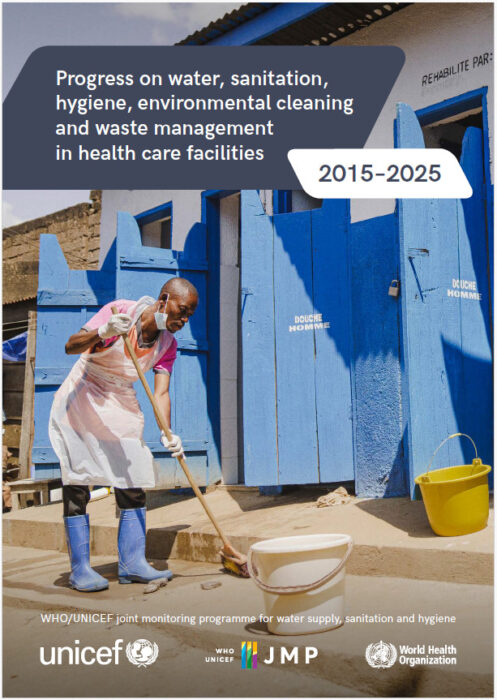

Only four in ten health care facilities worldwide met the basic sanitation standard in 2025, while six in ten met the standard for environmental cleaning. The new 2026 WHO/UNICEF Joint Monitoring Programme report, Progress on water, sanitation, hygiene, environmental cleaning and waste management in health care facilities 2015–2025, presents internationally comparable national, regional and global estimates for WASH in health care facilities. For the first time, global estimates are available for all five basic service areas.
Between 2015 and 2025, global coverage of basic water services increased from 76 per cent to 85 per cent, basic hygiene services from 55 per cent to 72 per cent, and basic waste-management services from 59 per cent to 71 per cent. Global data availability has improved steadily but changes in the countries contributing data mean the hygiene and waste-management trends should be interpreted with caution.
Major gaps remain. Only 40% of health care facilities met the requirements for a basic sanitation service, that is improved toilets that are usable and meet the needs of patients, staff, women and girls and people with limited mobility. There was no service at all at 11% of health care facilities, covering 936 million people. And only 59 per cent of health care facilities met the basic environmental cleaning standard, which requires both cleaning protocols and trained cleaning staff. Eighteen per cent had neither, corresponding to facilities covering approximately 1.5 billion people.
In numbers:
- 85 per cent of health care facilities had a basic water service
- 72 per cent had a basic hygiene service
- 71 per cent had a basic waste-management service
- 59 per cent had a basic environmental cleaning service
- 40 per cent had a basic sanitation service
- 39 countries had estimates for all five services, up from 29 in the previous JMP update
The report calls on countries to strengthen routine monitoring and move beyond measuring whether infrastructure is simply present. Monitoring should increasingly assess reliability, safety, accessibility and cleanliness, as well as whether services meet the needs of patients and health workers.
We invite you to explore the findings, integrate them into your work and share the report within your networks.