
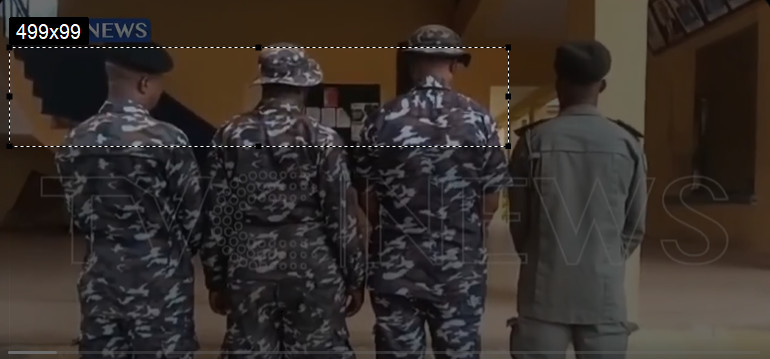

The Ondo State Police Command’s arrest of four officers filmed making ethnically offensive remarks during a stop-and-search has done little to calm public anger because the Force has not shown the officers’ faces, and Nigerians online say that omission is the real story.
The officers were filmed threatening to slap and detain a man reportedly just back from the UK after he declined to pay a bribe, with one officer telling him he was lucky not to be Igbo, since he would otherwise have been detained.
The video, confirmed by the Nigeria Police Force under Inspector General Tunji Disu, led to the arrest of four officers attached to the Ondo Police Command.
But rather than settling the matter, the arrests have triggered a wave of criticism focused on one demand: unmask the officers!
Across social media, Nigerians argue that concealing the officers’ identities protects them from scrutiny, makes it impossible for other victims to come forward, and casts doubt on whether the actual offending officers were even the ones detained.
D General (@AgbeyoAyomide) asked plainly why police routinely withhold officers’ faces, arguing that other potential victims might be able to identify and come forward as witnesses if they could see them.
Abuchi Chukwu (@Roddykris) was even blunter, calling the concealment itself a form of bias and misconduct, and insisting that the officers “must show their face.”
Andrea Terressa Rudison (@andrearudison) pointed to an apparent double standard, noting that officers accused of extorting the ICPC chairman had their faces shown publicly, while the officers in this ethnic-slur case have not been identified.
Padre (@Jimadec_Enterpr), writing in Pidgin, dismissed the idea that hiding the officers protects genuine police work, branding the anonymised men “corrupt bastards” and suggesting the cover-up itself signals guilt.
Ibrahim Bako (@mentalk2tv) noted the irony that the officers were filmed, despite turning their backs to the camera, while a separate officer allegedly involved, described as heavier-set, has not appeared in any footage at all, calling the selective visibility “ridiculous.”
Mazi Chijioke (@FreshChijioke) echoed the demand for the officers to turn and be seen, arguing that only visible identification can confirm they are, in fact, the men responsible.
@BlackIgboMan🇵🇭 (@ozo_versace) raised a related concern from the opposite angle: if these four are not actually the officers from the original viral video, they should show their faces to clear their names; anonymity, in this reading, harms the innocent and guilty alike.
John Onyi (@NkweguO37788) simply repeated the now-recurring refrain online: “show their face.”
The demand for visibility is tied to a deeper distrust that the arrests will lead anywhere. Pi LORD π (@PiL0RD) predicted the officers would quietly be transferred to another division rather than genuinely dismissed, suggesting anonymity today enables reassignment tomorrow.
Faceless (@Faceless_ng) drew a similar distinction, saying arresting officers are different from stripping them of their uniforms and prosecuting them in court and predicted neither full step would happen.
Engr. Christian Chukwu (@luvinxtain) linked the lack of transparency to a broader pattern, arguing that when citizens complain about such treatment, they are accused of playing victim, and that ethnic tensions have deepened since the 2023 elections.
JOHN €MODI (@ogendenoni) called for outright dismissal from the force, framing it as the only real deterrent against future incidents, implicitly rejecting quieter, less visible disciplinary routes.
Not every voice is centred on the anonymity issue. Gold Miner (@steveuba2) questioned whether these four officers were even the same men shown in an earlier viral video, suggesting confusion or misidentification was itself part of the problem.
Prince Oludare 🇳🇬 (@AdeoluwaBkk) took a more institutional view, arguing that accountability structures within the police matter more than any single incident, and that proven misconduct should trigger real disciplinary consequences.
Others, including moosaic (@mooosaic) and Mr CaPaBlE (@Mr__CaPaBle), credited the police command for acting swiftly at all, framing the arrests as a sign of progress even amid the criticism over transparency.
Still, the dominant tone across the thread was frustration that identification, not just arrest, is what victims and observers say they need to trust the process.
As Victor (@Victor80028552) put it, the danger is that the force will let the story become “just tribalism” while the more concrete wrongdoing, a bribery demand and threats against a civilian, go unaddressed behind anonymous badges.
It was heard that the NPF has not released the officers’ names, ranks, or photographs, and has not said whether they will face formal prosecution.