

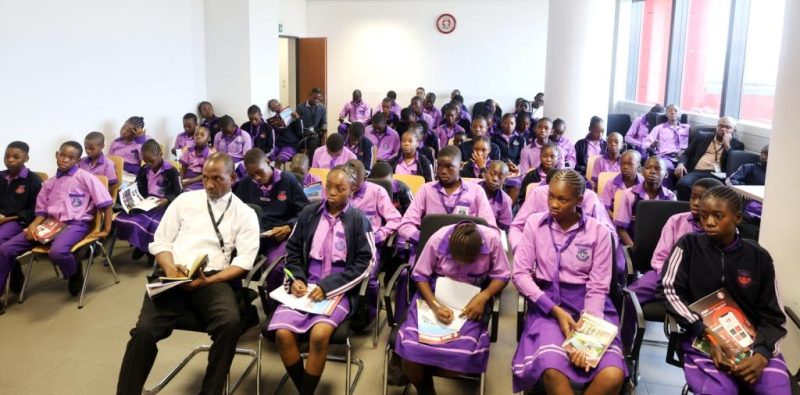

The Executive Chairman of the Economic and Financial Crimes Commission, EFCC, Mr Ola Olukoyede, has charged students across the country to make integrity their foundation, stressing that with such a foundation, future prospects of success will come handy.
He gave the charge in Abuja on Monday, March 9, 2026, while addressing students of J.K. People’s Comprehensive Academy M, Mararaba, Nasarawa State, who came on a study tour of EFCC’s Corporate Headquarters.
Olukoyede, who spoke through EFCC’s Head of Media and Publicity and Spokesperson of the Commission, Deputy Commander of the EFCC, DCE Dele Oyewale, noted that students that embraced integrity, accountable conduct and transparency will turn out to be leaders in their generation.
“ Your foundation is important. No superstructure can stand on a foundation of corruption. At this stage of your education, you have every opportunity to choose integrity. You cannot be wrong with integrity, and you cannot be right with corruption”, he said.
The EFCC boss further encouraged the students to aim high, broaden their vision and aspirations and dominate their environment for good.
On her part, the Head of Enlightenment and Re-Orientation Unit of the Commission, Assistant Commander of the EFCC, ACE II Aisha Mohammed, pointed out that prevention, investigation and prosecution are EFCC’s three-pronged approach to fighting corruption, economic and financial crimes. She highlighted television and radio sensitisation programmes and the establishment of Integrity and Zero Tolerance clubs in schools across the country and sustained collaboration with critical stakeholders as part of the Commission’s preventive efforts.
She charged the students to always tread the path of ethical behaviour as leaders of tomorrow. “You are the future of this country. If you get it right, Nigeria will get it right. Be content. Don’t allow anyone to pressure you into living beyond your means,” she said.
In a presentation on cybersecurity, Inspector of the EFCC, Kayode Eniola, educated the students on the nature and consequences of cybercrimes, describing cybercrimes as criminal activities perpetrated through digital communication tools and internet-enabled platforms. She identified phishing, hacking and online romance scams as common forms of cybercrime, adding that victims of cybercrimes often suffer financial losses, privacy breaches and reputational damage.
She further advised the students to adopt preventive measures against cybercrimes, such as using strong passwords, updating their software regularly, avoiding suspicious links and logging out of shared devices after use.
In his remarks, Okoro Chijioke, a teacher in the school, expressed gratitude to the EFCC and the students for an insightful event, describing it as “an unforgettable experience and one of the best so far.”
The event featured a question and answer session as well as a quiz competition in which the children’s understanding of the lecture was assessed. Two students, who emergedass inners, were presented with gifts and souvenirs.