
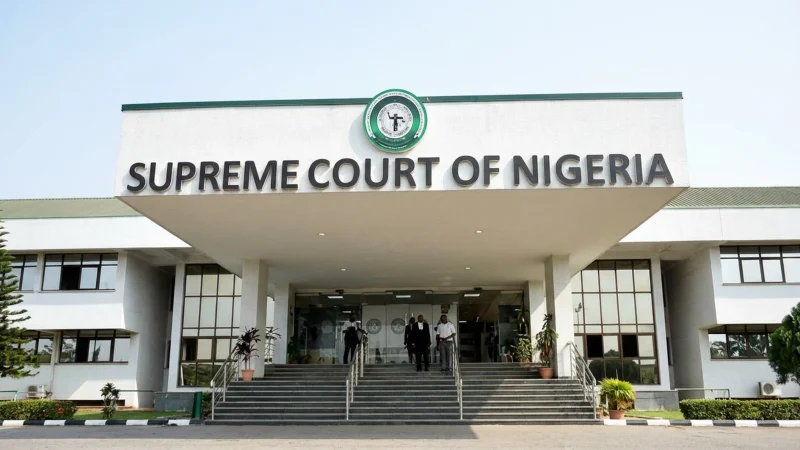

On 20 February 2026, the Supreme Court of Nigeria delivered a judgment that resonates far beyond the parties before it. In striking out the appeal filed by Shell Petroleum Development Company of Nigeria (SPDC) against Tunde Adjoto, the Court reaffirmed a critical constitutional boundary.
The lead judgment was delivered by Hon. Justice John Inyang Okoro, who sat with four other Justices, all concurring.
In reaching its decision, the apex Court relied on its earlier authorities in Sky Bank v Iwu and Coca-Cola v Akinsanya, holding firmly that it lacks appellate jurisdiction over labour and employment matters pursuant to the Third Alteration to the 1999 Constitution. The appeal was struck out with punitive costs of ₦5 million.
As articulated in his Preliminary Objection, counsel to Tunde Adjoto, Mr Isaac M. Boro, argued that the legislative arm of government deliberately inserted this constitutional provision to insulate the Supreme Court from unnecessary appeals that ought to terminate at the Court of Appeal. The duty of the Supreme Court, he submitted, is to interpret the clear and unambiguous provisions of the Constitution – not to expand them. The Court agreed, describing the appeal as unmeritorious and an abuse of court process.
*Beyond Procedure: The Human Rights Dimension*
This judgment is not merely procedural. It is profoundly rooted in human rights principles.
Labour rights are human rights. The right to fair treatment at work, protection from arbitrary dismissal, and freedom from intimidation are central to human dignity and social justice. When employment disputes are prolonged for years through procedural manoeuvres, the imbalance of power between corporations and individual workers becomes glaring.
For nearly two decades, Tunde Adjoto’s case traversed the judicial system. After securing judgment in his favour at the trial court and seeing SPDC’s appeal struck out by the Court of Appeal for want of diligent prosecution, the dispute nonetheless persisted.
The subsequent attempt to reopen the matter through a fundamental rights action – effectively to draw the case to the apex Court – underscores a troubling reality: well-resourced corporate actors can deploy procedural tactics to exhaust and frustrate individual litigants.
The Third Alteration to the Constitution was enacted precisely to prevent endless litigation in labour matters. By firmly enforcing that constitutional boundary, the Supreme Court has reinforced the principle that clarity of law must not be undermined by procedural ingenuity.
*Corporate Power and Accountability*
Corporate accountability extends beyond regulatory compliance. It encompasses respect for the rights, dignity, and lawful entitlements of workers.
When a corporation of significant economic influence engages in prolonged litigation over employment rights, the consequences are far from neutral. Delays in justice can deprive workers of the fruits of lawful judgments, inflict financial hardship, and discourage others from seeking redress.
Access to justice must be real, not theoretical.
The award of punitive costs is therefore consequential. It signals that abuse of court process – particularly where there is a visible asymmetry of power – will attract judicial sanction.
In a country where many workers fear retaliation for challenging unfair labour practices, the courts must remain, and must be seen to remain, a credible counterweight to corporate excess.
*Restoring Public Confidence*
Public confidence in the judiciary is strengthened not by rhetoric but by fidelity to constitutional limits and fairness. By reaffirming its lack of jurisdiction and striking out the appeal, the Supreme Court has:
– Upheld constitutional discipline,
– Protected the finality of labour adjudication, and
– Sent a clear message that justice cannot be indefinitely deferred through technical stratagems.
For workers across Nigeria, this judgment stands as reassurance that the legal system can, ultimately, hold powerful institutions accountable.
Justice delayed is costly. But when constitutional principles are courageously upheld, justice regained strengthens not just one individual – it strengthens the rule of law.
Mr Okechukwu Nwanguma is the Executive Director, RULAAC