
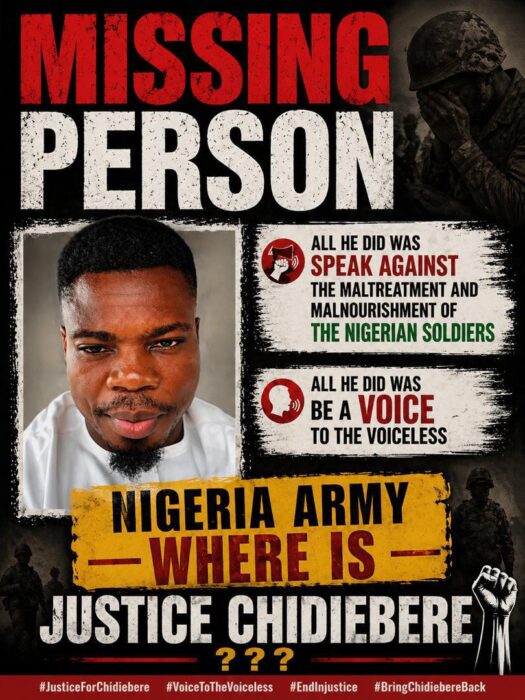

The Rule of Law and Accountability Advocacy Centre (RULAAC) has criticised the Nigerian Army’s recent statement on the arrest of social media influencer Justice Mark Chidiebere, saying it raises more concerns than it resolves.
In a statement issued on May 2, 2026, RULAAC’s Executive Director, Okechukwu Nwanguma, described the Army’s response as a delayed attempt at damage control following public outrage over the arrest.
The group expressed concern over what it called the Army’s silence for several days after Chidiebere’s arrest, noting that the eventual statement came five days later. According to RULAAC, such delays undermine transparency and erode public trust, particularly in a democratic setting where security agencies are expected to act within the bounds of the law.
RULAAC also faulted the Army’s justification for the arrest, which allegedly linked Chidiebere to conversations with soldiers that “incited discontent” or bordered on subversion. The organisation described the claims as vague, warning that citizens’ constitutional right to freedom of expression must not be criminalised without clear and verifiable evidence.
The group further argued that discussing issues such as the welfare of military personnel falls within legitimate public discourse and should not be framed as a security threat.
RULAAC stressed that if any wrongdoing is established, due process must be followed. It maintained that the Nigerian Army does not have broad powers to detain civilians and should, where necessary, hand over suspects to appropriate civil authorities while ensuring access to legal representation and family members.
The organisation also urged authorities to address underlying concerns about soldiers’ welfare, rather than targeting individuals who bring such issues to public attention.
Among its demands, RULAAC called on the Army to provide a detailed account of the arrest, including the legal basis and location of detention, disclose Chidiebere’s whereabouts during the period he was reportedly held incommunicado, and guarantee respect for his fundamental rights.
It also urged the military to refrain from suppressing free expression and instead focus on accountability, transparency, and adherence to the rule of law.
“The credibility of our institutions depends not on their ability to suppress criticism, but on their willingness to uphold accountability,” the statement added.