
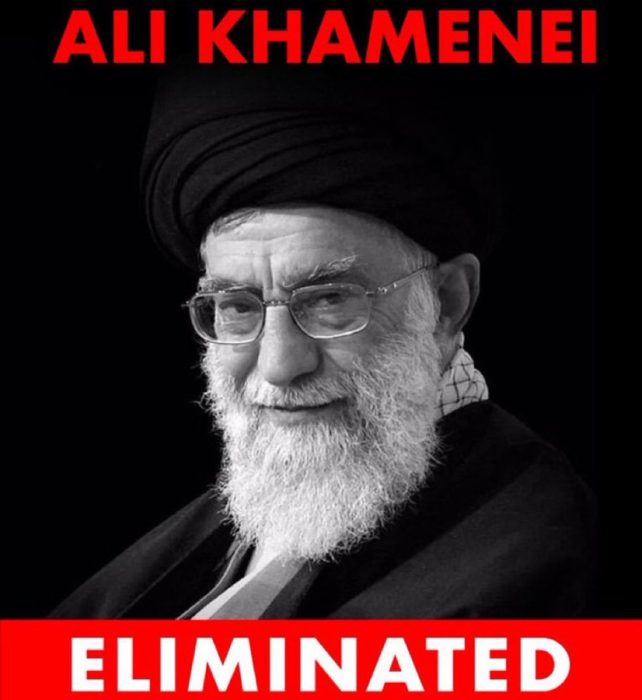

Reports have emerged of the killing of Iran’s Supreme Leader, Ayatollah Seyyed Ali Khamenei, following an alleged airstrike on his office.
According to Dr Abdul Majid Hakeem Ilahi, Khamenei’s representative in India, the Supreme Leader refused repeated security requests to relocate from his office despite threats.
“Ayatollah Khamenei was in his office, and several times the security asked him to move from his office to another city, and he refused. He said if you could move 90 million Iranians to another city, I will move after that,” Ilahi said. “In the morning, the aircraft of the Zionist regime and America attacked his office. He, his wife, his daughter-in-law, and some of his nephews pass away…”
Ilahi added that Khamenei’s death would not weaken Iran’s resolve: “His blood will bring more power and also more energy, and more awareness to society, and the people will follow his path and his way.”
The news caused a wave of polarised responses across social media.
Some users mocked the narrative of martyrdom, with one writing, “His blood will bring more power and awareness, classic martyrdom spin. Meanwhile, Iranian Gen Z in the streets are celebrating his death.”
Others expressed anger, calling him a tyrant, while Iranian dissidents celebrated, saying, “He doesn’t have any followers in Iran. We want regime change. Revolution is the last solution. God bless Israel, America, and Persia.”
At the same time, condolences were offered by sympathisers.
One user wrote, “My heart is saddened to hear the news of the death of Supreme Leader Sir Ayatollah Ali Khamenei. I offer my heartfelt tributes.”
Another echoed Ilahi’s words, insisting that his martyrdom would inspire followers worldwide. Others dismissed expressions of grief as “crocodile tears” and accused clerics of “spewing venom.”
Ayatollah Ali Khamenei had been Iran’s Supreme Leader since 1989, a tenure marked by repression, executions, and violent crackdowns on dissent. Estimates suggest over 20,000 executions since 1989, with more than 2,200 in 2025 alone.
Protest movements were met with deadly force: in 1988, 3,000–5,000 political prisoners were executed; in 2009, the Green Movement saw 40–100 killed; in 2019, fuel protests left around 1,500 dead; in 2022–23, the “Woman, Life, Freedom” protests resulted in over 500 deaths, including children; and in 2025–26, economic unrest led to thousands killed, with activists claiming tens of thousands in a single crackdown.
Critics described him as a dictator who supported militant groups such as Hezbollah, Hamas, and the Houthis, while suppressing women’s rights and dissent at home.
Some social media commentators hailed his death as the end of a tyrant, with one writing, “The butcher is dead, and the world is now a better place,” while another declared, “The Hijab Curtain has fallen.”
Others warned of instability, predicting that India and the wider region would face repercussions. The killing has triggered both mourning and celebration, underscoring the deep divisions over Khamenei’s legacy. #securitynewsalert.com.