
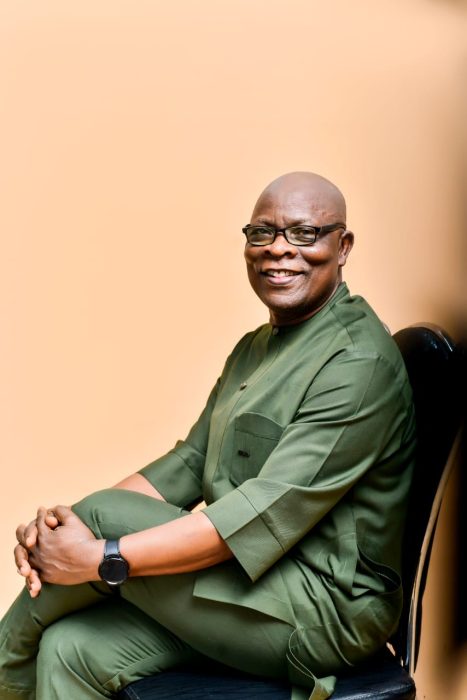

JULIANA FRANCIS continues her exclusive conversation with retired Commissioner of Police, Chief Olusola Amore. In this instalment, Amore revisits his early career in journalism before transitioning into the Nigeria Police Force. He passionately champions improved welfare for media professionals, asserting that journalists deserve respect, not charity. Emphasising the importance of credibility and standards, he advocates for the introduction of professional licensing to elevate journalism beyond an open-door vocation.
What Lured You From the Classroom To Journalism
What led me from the classroom to journalism was my experience at the College of Education, where I co-studied English and Yoruba languages and served as Editor of the Press Club.
Every morning, before most people were awake, I would gather my observations and reports about events happening around the college. I’d compile them and post everything on the press board, where students would gather to read. This made me a bit popular among my peers.
Of course, not everyone appreciated being in the spotlight, especially when something they’d done that I didn’t approve of got exposed. Some would look for me, accuse me of stirring up trouble, and I’d sometimes have to go into hiding or make myself scarce.
That’s how journalism found its way into my life while still in school. So when I left the College of Education and my colleagues were preparing to pursue degrees in education, I shifted focus and chose to study mass communication instead.
Back then, after completing the NCE program, the next step was to participate in the National Youth Service Corps. After finishing my youth service in 1979/1980, I applied to the University of Lagos to study mass communication, and that was how my journey in journalism truly began.
What Do You Hate And Like Most About Journalism?
What I hate most about journalism is the way media owners exploit reporters.
Journalism has two sides: the business side and the professional side. As a journalist, you go out to gather news. But when that news affects powerful individuals, those at the top pull strings to negotiate you out of the situation. That is one of the things I deeply dislike about this profession.
And then there’s the condition of service. Journalists are living in poverty, almost like beggars. Many are unpaid, while others receive their salaries late, sometimes two or even three months behind schedule.
This forces them to depend on gifts and, at times, behave like beggars simply because they aren’t paid regularly.
When I first became a Police Public Relations Officer (PPRO), I often challenged journalists on this issue. I would share the details of police salaries and ask: “Is your salary enough for you? Are you paid regularly?” At that time, some media organisations, both print and television, were notorious for owing their workers six months’ salary. Some, which I won’t name, owed up to nine months. This is what frustrates me most about journalism.
When I joined The Punch, I made it a point to understand the situation. I observed those who had worked there for 10 or 15 years and looked at the lives they were living. I told myself, “If this is how far they’ve come in all that time, then I certainly haven’t reached my bus stop.”
Back then, there was a columnist writing for The Punch, and I would regularly engage him in conversation.
He told me, “I’m critical of the police. If you want to change a system, you have to be part of it. You can’t change it from the outside. You can only change a system from the inside.”
What Do You Think Media Organisations Can Do To Improve the Welfare Of Journalists And Check Corruption?
Well, when it comes to the journalism of yesterday and today, there isn’t much difference except that social media has significantly influenced the practice today.
Many journalists can now have their online publications, unlike in the past when one depended mainly on working for a major news outlet.
By and large, the public’s perception of journalists hasn’t changed much. However, the welfare of journalists needs attention.
I believe the government should enact legislation just like in the medical field for nurses that ensures journalists have a minimum earning threshold.
The journalism profession also needs to regulate its practice, because journalism isn’t meant for just any Tom, Dick, or Harry.
I’m not against people who studied geography, animal science, or other fields becoming journalists. But if you’ve studied something outside journalism, you should be required to attend journalism school for at least nine months to be licensed to practice.
I believe journalists should be licensed. If you don’t have that license, you shouldn’t be allowed to practice. These days, you see someone with only a school certificate writing news for an organisation and calling themselves a journalist!
You have individuals with degrees in biology or geography writing news in fields they barely understand, yet they’re all called journalists.
There are also on-air personalities (OAPs) who call themselves journalists but know nothing about the ethics of the profession or the laws guiding journalistic practice.
These gaps need to be addressed if we truly want to improve the welfare of journalists.
Just like in the legal profession, you can’t study geography or animal science and simply walk into a courtroom as a lawyer.
Many professions have had similar challenges. For example, in teaching, the establishment of the Teachers Registration Council helped professionalise the field. Today, if you’re not registered with the Council, you’re not allowed to teach.
Journalism should follow a similar path. Yes, you can study geography or any other discipline, but you must undergo six to nine months of journalism training before being licensed and allowed to practice.
What Is Your Take On Journalists Targeted For Doing Their Jobs, and What Can Be Done To Check These Attacks
Journalists who are targeted for doing their job honestly, I don’t know what should be done in such cases.
Journalism is a field where there’s often a thin line between doing one’s job and crossing into blackmail.
Some of our brothers receive valuable information and misuse it to extort people. It’s difficult because they know that if they submit the story, their senior editors might trade it with the subject of the news.
So, instead, they approach the person and say, ‘Look at this news we uncovered about you. Should we go to the media or come to you first?’
It is during this kind of negotiation that many journalists are attacked or have their lives threatened. But if you practice journalism ethically, you’d simply contact the person and say, ‘We have this information. What is your response?’ Even if the person says, ‘I have no comment,’ you write what you have and include that they declined to respond. That way, there’s no reason for them to target you or investigate your personal life.
Journalism is a noble profession, just like any other job. It’s how you practice it that defines its value. I truly enjoyed my brief time at The Punch newspaper.
I’m always proud to say, ‘Yes, when we were at The Punch, it was during the time of, I think, Shaq Gary. We did solid work under our editor, Bemi. Nath Adewole was a sub-editor. Ademola Oshinobi was our news editor.
We were all there together, including the current minister, now Chairman of the Postal Authority.
They worked at the officials’ desk, which we called a madhouse because everyone had ideas and was free to contribute before the paper went to bed.
Journalism is a great profession, but it needs a proper structure. There should be clear laws governing who can practice. There’s a need for licensing, and a minimum salary should be established so journalists can live with dignity. They shouldn’t be viewed as beggars, and they must also conduct themselves with integrity, not as beggars.