
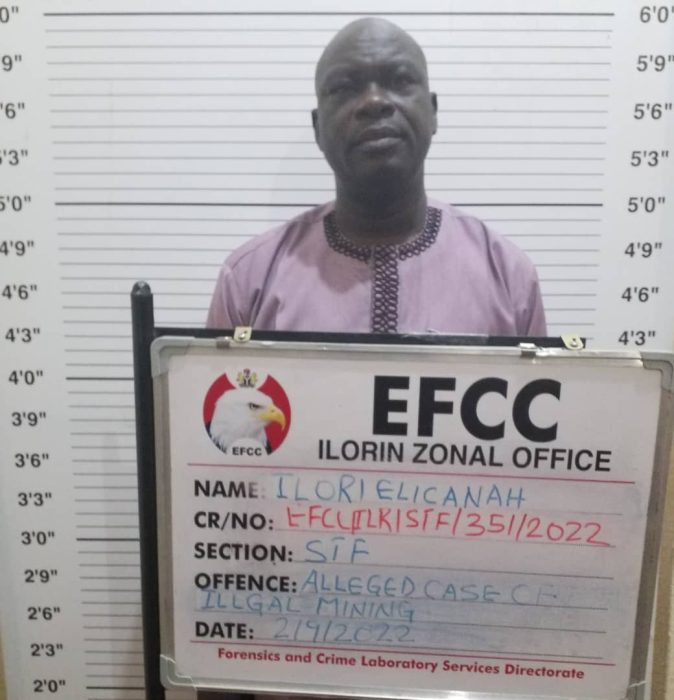

The Ilorin Zonal Directorate of the Economic and Financial Crimes Commission (EFCC) has secured a landmark conviction in its ongoing crackdown on illegal mining activities.
A Kwara State High Court on Wednesday sentenced 52-year-old Ilori Elicanah to five years’ imprisonment for unlawful possession of solid minerals.
Delivering judgment, Justice Abimbola Awogboro found Elicanah guilty of mining and possessing solid minerals without lawful authority, contrary to the provisions of the Miscellaneous Offences Act, Cap M17, Laws of the Federation of Nigeria, 1983.
“The defendant does not possess a licence, and there is no record showing payment of royalties to the Federal Government as stipulated by law,” Justice Awogboro declared while pronouncing the sentence.
The EFCC had arraigned Elicanah in October 2024 on a one-count charge bordering on illegal possession of solid minerals. The charge stated: “That you, Ilori Elicanah, sometime in September 2022, within the jurisdiction of the Federal High Court, without lawful authority, mined tonnes of minerals conveyed in truck with plate number BDG678XU and chassis number LGWSRXPHHIGAD82084, contrary to and punishable under Section 1 (8) (b) of the Miscellaneous Offences Act CAP M17, 1983.”
During the trial, the prosecution presented two witnesses and tendered exhibits marked A–E to establish Elicanah’s culpability. The defence, led by the convict himself and three other witnesses, closed its case on July 11, 2025.
In his final written address, EFCC counsel Sesan Ola urged the court to convict the defendant, stressing that the prosecution had proved its case beyond a reasonable doubt.
“My Lord, the defendant, DW1, DW2 and DW3 all admitted that the defendant does not possess a licence to mine, despite their claim that he operated under a verbal instruction from Tascon Plastic Industry Nigeria Limited’s mining lease,” Ola argued.
The prosecution relied on Section 1 of the Nigerian Minerals and Mining Act, 2007, which vests ownership and control of all mineral resources in Nigeria in the Federal Government on behalf of the people.
Justice Awogboro ruled that the sole issue for determination was whether the defendant had lawful authority to possess solid minerals as required by law. She held that the EFCC had successfully established all the ingredients of the offence and complied with Section 131 of the Evidence Act.
The court dismissed the defence’s argument that the prosecution failed to call certain witnesses, describing the EFCC’s evidence as “credible, strong, and reliable.”
Consequently, Elicanah was convicted and sentenced to five years’ imprisonment.