


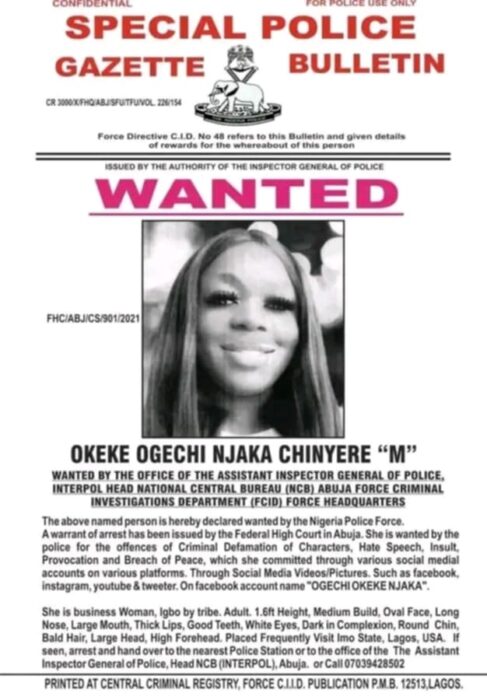
The Community Court of Justice of the Economic Community of West African States (ECOWAS) has ordered the Federal Government of Nigeria to remove a wanted notice issued against a Nigerian woman, Mrs Ogeche Njaka, and pay her ₦1 million in compensation for violating her rights to presumption of innocence and human dignity.
The judgment was delivered in Case No. ECW/CCJ/APP/18/24, in which the court found that a publication declaring Njaka wanted over alleged criminal offences improperly portrayed her as guilty before any judicial determination of guilt.
Njaka, a Nigerian resident in the United States who runs a non-governmental organisation and a Facebook matchmaking programme, instituted the suit through Abuja-based human rights lawyer Samuel Ihensekhien Junior.
According to court documents, Njaka alleged that she became the subject of defamatory attacks and a criminal complaint after reporting an individual over allegedly defamatory social media posts.
She told the court that a complaint lodged by one Maryam Shehu led a Nigerian security agency to declare her wanted and obtain a warrant for her arrest without first notifying her of the allegations against her. Although the criminal case was later struck out for lack of diligent prosecution, she argued that the security agency continued to display and permit the circulation of the wanted notice.
Njaka contended that the publication violated her fundamental rights, including her rights to presumption of innocence, human dignity, equality before the law, and to be informed of criminal charges.
In its defence, the Federal Republic of Nigeria maintained that several attempts had been made to invite the applicant for questioning but that she failed to honour the invitations. The government also argued that the security agency lawfully obtained an arrest order from the Federal High Court before issuing the wanted notice.
In its judgment, the ECOWAS Court affirmed its jurisdiction to hear the matter and declared the application admissible, noting that the applicant had established her status as an alleged victim of human rights violations and that the case was not pending before any other international court.
On the issue of presumption of innocence, the court held that the wording of the wanted notice exceeded merely identifying Njaka as a suspect.
The court observed that the notice stated she was wanted for offences she had “committed” through various social media platforms.
According to the court, the language used portrayed the applicant as guilty of criminal offences before any trial or conviction.
“The wording of the notice went beyond presenting the Applicant as a suspect and instead portrayed her as guilty of criminal offences before any trial or conviction,” the court held.
It consequently found that Nigeria violated Njaka’s right to be presumed innocent under Article 7(1)(b) of the African Charter on Human and Peoples’ Rights and Article 14(2) of the International Covenant on Civil and Political Rights.
The court also ruled that the publication violated her right to human dignity, noting that publicly portraying an individual as having committed criminal offences before a judicial determination of guilt could expose such a person to stigma, humiliation, social exclusion and reputational damage.
However, the court dismissed Njaka’s claim that her right to equality before the law had been violated, stating that she failed to provide evidence showing she was treated differently from other persons in similar circumstances.
The judges also rejected her claim that she was denied the right to be informed of criminal charges, holding that she had neither been arrested nor formally charged and that the wanted notice itself identified the offences under investigation.
Consequently, the court declared that Nigeria violated Njaka’s rights to presumption of innocence and human dignity but found no violation of her rights to equality before the law or to be informed of criminal charges.
As part of its orders, the ECOWAS Court directed the Federal Republic of Nigeria to remove the wanted notice from the bulletin of the Nigeria Police Force and any other platform where it was published.
The court also ordered the government to publish the judgment in its Official Gazette and on the website of the Nigeria Police Force for six months, and to pay Njaka ₦1 million as compensation for the violations established by the court.
All other claims brought by the applicant were dismissed. #Securitynewsalert.com