


Lagos State Governor Babajide Sanwo-Olu used a high-profile political lecture in Ikeja on Thursday to make an explicit case for the ruling All Progressives Congress (APC) heading into the 2027 general election, framing the vote as a test of Nigeria’s economic recovery and security gains under President Bola Ahmed Tinubu.
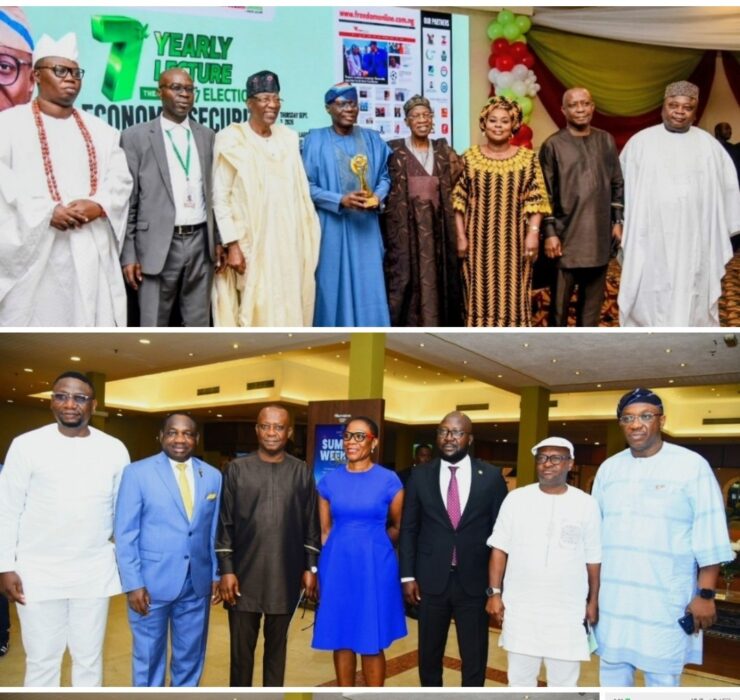
Delivering the keynote at the 7th Freedom Online Yearly Lecture, themed “2027 Elections: Economy, Security and Nigeria’s Future,” Sanwo-Olu addressed a room of politicians, editors and policymakers at the Sheraton Hotel, Ikeja.
Former Information Minister Lai Mohammed chaired the event, with former Ogun State governor and sitting Senator Gbenga Daniel as Special Guest of Honour.
Sanwo-Olu did not pretend to be a neutral broker. Speaking in the final months of his second term, a term that will keep his own name off the 2027 ballot, the governor said that freed him to speak candidly rather than campaign for votes.
He identified himself plainly as an APC loyalist who backs Tinubu’s reform agenda, while insisting he would try to speak first as a Nigerian and only second as a partisan.
He framed 2027 against the long arc of Nigeria’s democratic history, noting that by the time polls open in January, the Fourth Republic will have run 28 years longer than the First, Second and Third Republics combined.
He also flagged how few of Nigeria’s West African neighbours, including Mali, Guinea, Burkina Faso, Niger and Guinea-Bissau, have avoided military takeovers in recent years, arguing that Nigeria’s unbroken run of elections since 1999 should not be taken for granted.
Anticipating that opposition parties will campaign on restoring fuel subsidies, Sanwo-Olu pushed back directly, describing subsidy-return promises as populist and ultimately hollow.
He argued the subsidy regime had for years drained money that should have gone to schools, hospitals and healthcare, and credited its removal with helping produce recent economic gains including growth data reported by the National Bureau of Statistics, expanding external reserves, easing inflation from its late-2024 peak, and record diaspora remittance inflows tracked by the Central Bank.
The governor tied economic performance directly to security, arguing that poverty fuels insecurity and insecurity chokes off the growth needed to fight poverty.
He pointed to the expansion of military divisions, new police recruitment, and a new presidential office coordinating homeland security as evidence that the Tinubu administration has prioritised the issue.
He also used the topic to make the case for state policing reform, an issue he described as central to how effectively security dollars translate into public safety, drawing on Lagos’s own two-decade experience with community-level security funding as a model.
To illustrate his argument that the ruling party is not rigging outcomes, Sanwo-Olu pointed to a recent governorship election in Osun State, where the APC candidate lost decisively to an opposition rival.
He said Tinubu’s response, congratulating the winner and pledging federal cooperation rather than contesting the result, showed a level of democratic restraint he contrasted with Nigeria’s past.
On the mechanics of the vote itself, Sanwo-Olu credited the Electoral Act of 2022 and a newer 2026 Electoral Act, along with voter-verification technology, for improving Nigeria’s election administration compared with the 2000s.
He said INEC must be ready in every polling unit on January 16, 2027, and again on February 6, 2027, and that everyone involved has a duty to help the commission meet that standard.
Sanwo-Olu closed by pointing to Tinubu’s stated ambition of a $1 trillion economy by 2030, alongside plans which Sanwo-Olu said he is co-chairing to position Lagos as an international financial hub along the lines of London, Dubai or Hong Kong.
He was direct about his own expectations for the vote, saying he wants his party to win and expects Tinubu to secure a second term, while maintaining that whatever the outcome, Nigeria’s democracy would register the election as another milestone.


