
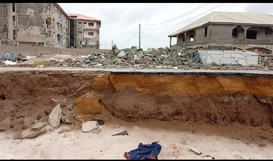

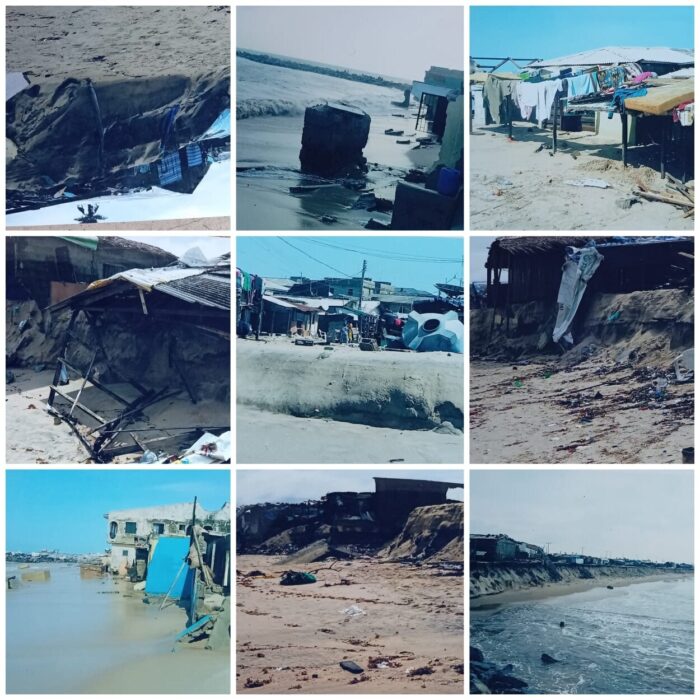
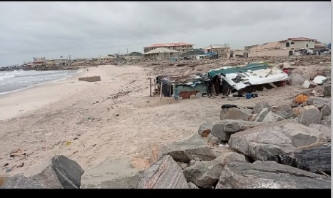
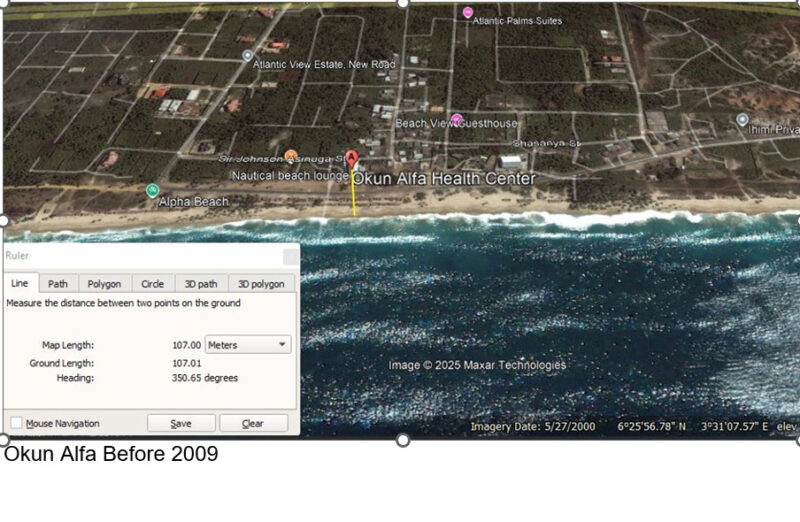
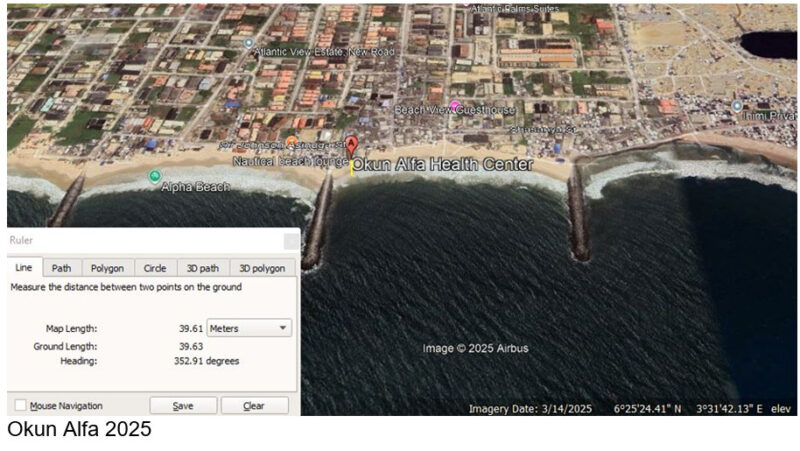
Once a thriving tourist hub and residential community, Okun Alfa (Alpha Beach) was devastated by a 2009 ocean surge that destroyed homes and claimed lives. Juliana Francis reports that the Eko Atlantic City project and unbridled sand dredging activities pose new threats to its continued existence.
When first approached for an interview, Ms Adejat Murayo, whose ancestral home in the coastal community of Okun Alfa in Lagos was wiped out by ocean surges, refused to speak.
She was visibly angry.
“I don’t want to be interviewed; I have nothing to say,” she said. “My mother’s burial site is in the ocean. Everything is gone!”
Weeks later, she agreed to speak briefly.
She recalled the night the disaster struck in 2009, when the Atlantic Ocean washed away the 10 houses she inherited from her late mother.
She said it occurred at about 1 a.m., while most residents were asleep. Waves surged violently into the community. Families woke to chaos—parents grabbing children and fleeing into the darkness as water swallowed homes.
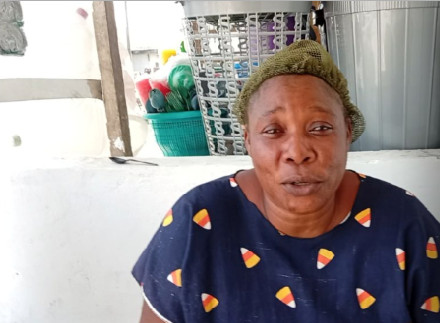
“It was a nightmare,” she said quietly. “Please, I don’t like talking about these things.”
Nearly two decades later, the trauma lingers—and so does the threat.
The Night the Ocean Took Everything
Olayinka Ajandi, a struggling architect in his 40s, said residents had initially noticed unusual waves at dusk but assumed they would pass without incident.
They did not.
“By 1 a.m., it came with full force. Many people were asleep. Not everyone could swim.”
He described the sound of waves crashing into buildings, the panic, and the screams.
“Those of us who survived did so because we could swim. Later, the ocean returned bodies to what was left of our community.”
The surges did not stop after 2009.
Ajandi said they continued until the administration of former Lagos State governor Babatunde Raji Fashola installed shoreline breakers.
“If not for those breakers, the community would have disappeared,” he said.
Still, the damage was irreversible.
“My father lost seven buildings. The shock killed him. He kept asking how to start again.”
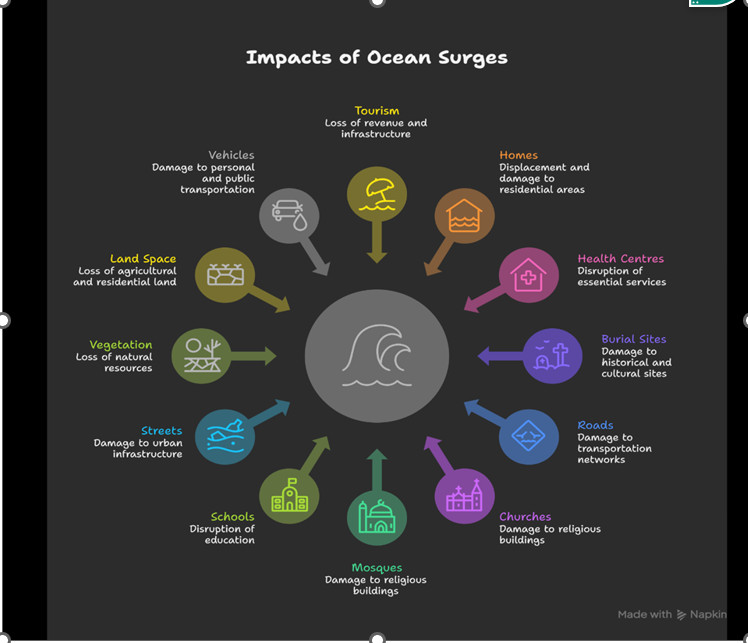
Many families whose homes were destroyed in surges have had to relocate. But indigenous landowners like Murayo and Ajandi said they have nowhere else to go.
Murayo says the community’s health centres and schools were flooded, so women now must travel far to access medical care.
Residents trace the beginning of recurring surges to 2008, when sand dredging for the Eko Atlantic project began.
“The first surge happened in 2009, and the ongoing Eko Atlantic City project started sand mining from the sea in 2008. That was when we first noticed their activities,” Ajandi said.
The project promises to transform Lagos into the “Dubai of Africa.” But for Okun Alfa residents, it has brought fear, despair, loss, and uncertainty.
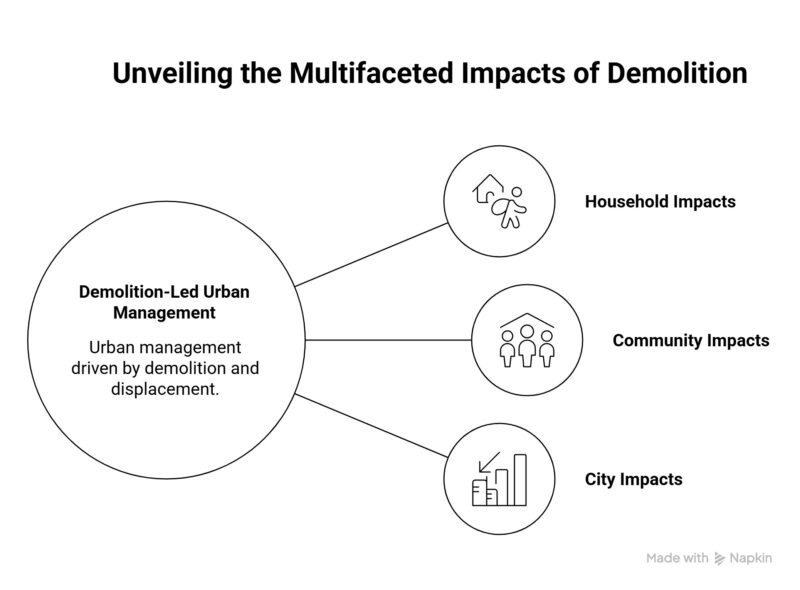
A 2025 Report, Lagos: City Report by African Cities Research Consortium (ACRC), states that coastal displacement in Lagos is primarily driven by climate-related flooding and forced evictions.
Data by ACRC
The report states that approximately 18% of Lagos, a low-lying coastal city with poor drainage and rising rainfall, is becoming increasingly prone to flooding, with waterfront communities facing the greatest risk of flooding and displacement.
ACRC also states that the All Progressives Congress (APC) vision of making Lagos more beautiful and modern has led to the demolition of many slum communities, often in harsh ways.
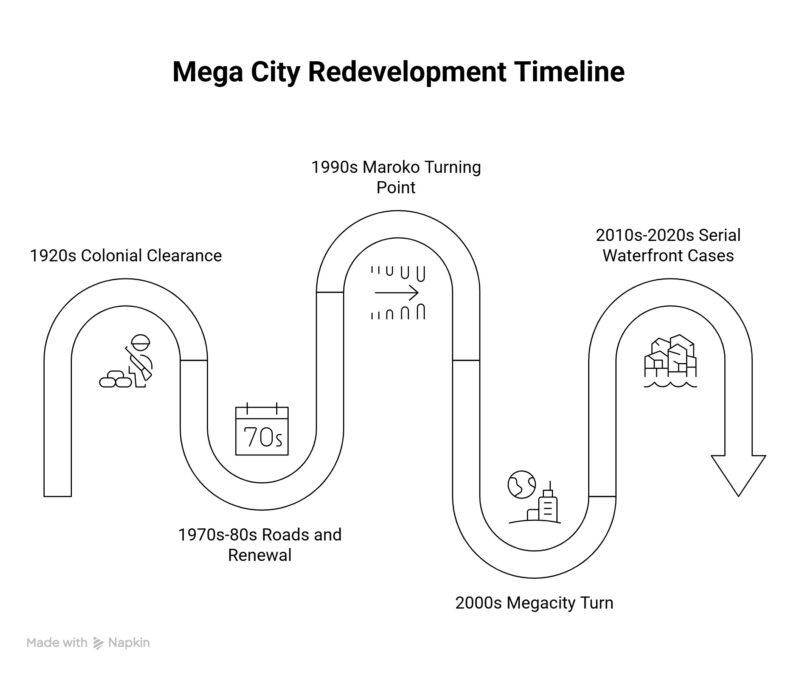
DATA BY ACRC
According to the report, residents of Lagos are being forced to abandon their ancestral homes and livelihoods as the Atlantic Ocean continues to erode the coastline.
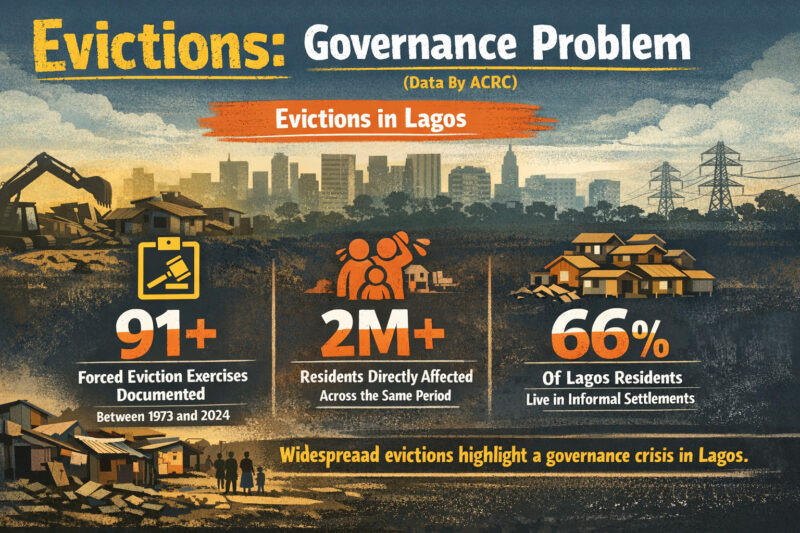
DATA BY ACRC
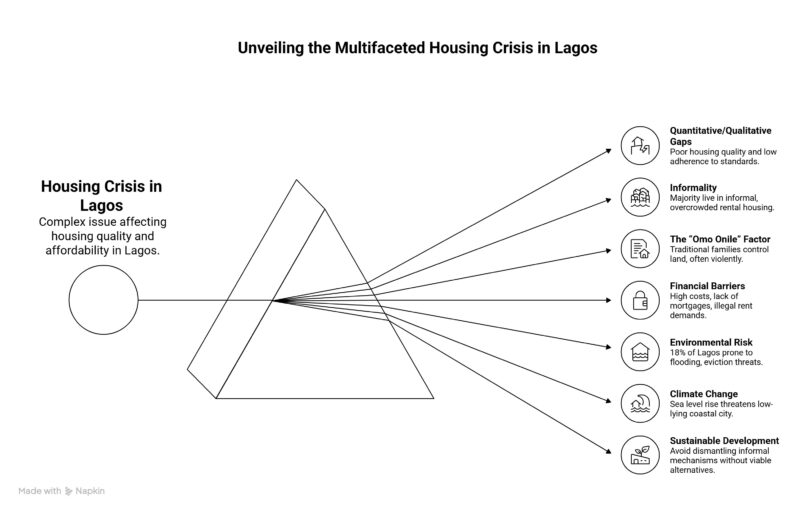
Eko Atlantic: The Project and Its Controversy
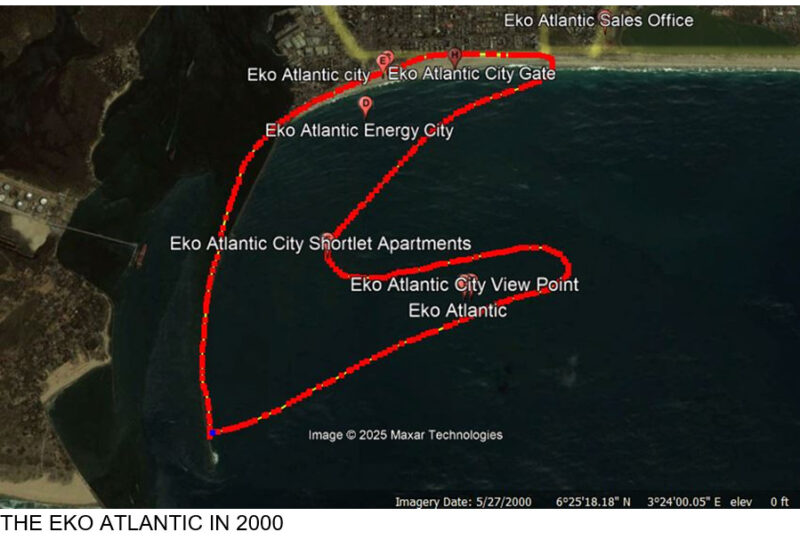
The Lagos State Government, in partnership with private investors such as South EnergyX Engineering Limited, initiated the Eko Atlantic project in the early 2000s.
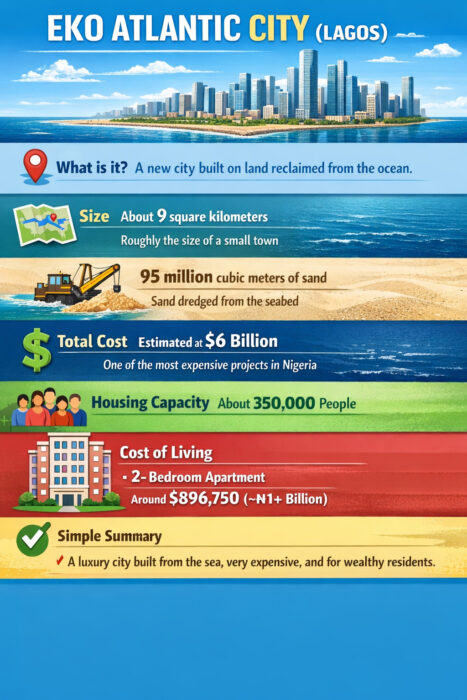
According to EnvironewsNigeria, the development sits on land reclaimed from the Atlantic—about 9 square kilometres—created using roughly 95 million cubic metres of sand. The project, estimated at $6 billion, is designed to house about 350,000 people.
A two-bedroom apartment sells for nearly $900,000, roughly ₦1.3–₦1.4 billion.
Critics argue that the project prioritises the wealthy while exposing poorer coastal communities to environmental risks.
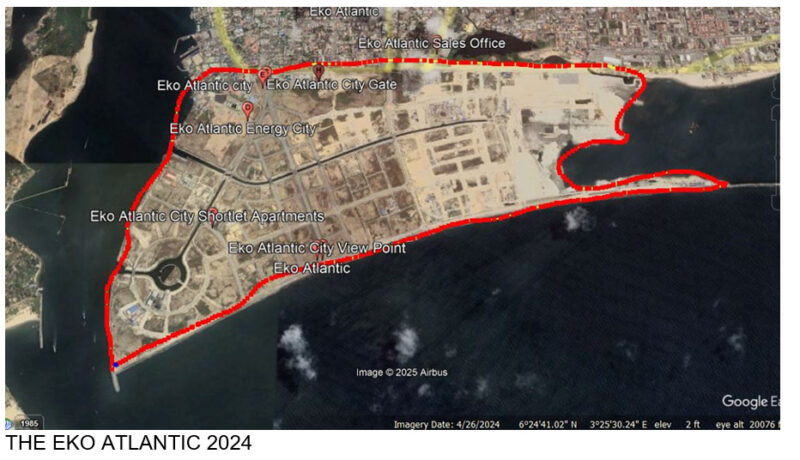
In 2008, the Lagos State House of Assembly enacted the Waterfront Infrastructure Development Law (LAWID), granting the state authority to approve dredging activities.
But environmental advocates say the law enabled the project to proceed without proper federal approval.
The Executive Director of Spaces for Change (S4C), Victoria Ibezim-Ohaeri, argues that dredging commenced before the required Environmental Impact Assessment (EIA) was approved.
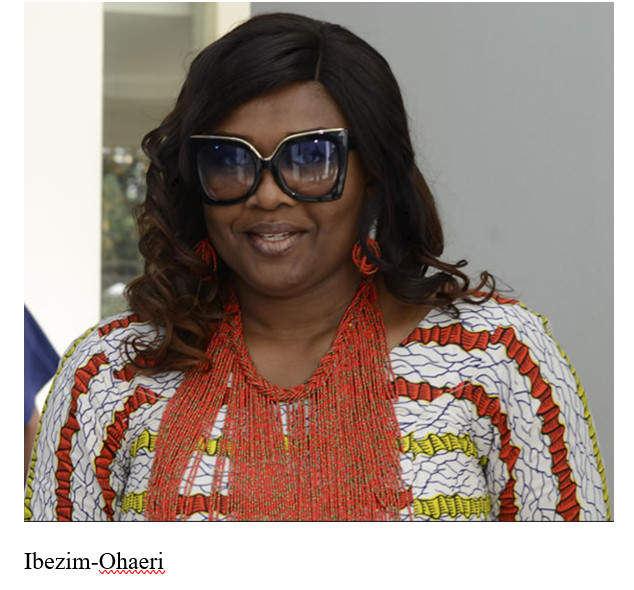
“We raised objections, yet the project continued. A state law was used to bypass federal oversight,” she said.
The EIA was submitted in 2011 and approved in 2013, years after dredging had already begun on the project.
Civil society groups, like Spaces For Change (S4C) and The Legal Defence and Assistance Project (LEDAP), argued that the Lagos State Government did not comply with proper environmental regulations when it began the Eko Atlantic project.
LEDAP challenged the project in court, warning it could worsen flooding and damage marine ecosystems, calling for an end to the ongoing Eko Atlantic City project and the dredging of the Atlantic Ocean.
In a suit to the Federal High Court, Lagos, in 2015, LEDAP stated that the defendants did not conduct an Environmental Impact Assessment, as required by law, before embarking on the project.
It warned: “To continue with the project will be detrimental to the environmental safety of communities along the coastal banks of the Atlantic Ocean.”
Sand Dredging and the Loss of Livelihoods
The Baale of Okun Alfa, Chief Yusuf Olatunji Elegushi Atewolara, says sand dredging activities caused the ocean surges.
“At that time, the government pumped sand to their own site (Eko Atlantic Project), and the water stopped us here. Many of our coconut trees, fish houses, and others were destroyed,” he said.
Atewolara noted that Okun Alfa, located along the Elegushi coastline, was once a thriving hub for local tourism and fishing activities.
“We had many customers coming to Elegushi. Even white people came. We created this place for them. There were many buildings, including hotels. Foreigners came to relax and enjoy themselves,” he said.
He explained that before the environmental changes, residents depended on fishing and local food businesses, adding: “During the rainy season, the water used to rise the way it did before, but now it has reduced. Since sand dredging stopped, the surge has not returned. If it comes at all, it is just briefly, and then it goes back.”
“The government filled places like Idotun and Oshoroko, and parts of Lekki, where ships come to offload cargo. But here, no filling was done.”
The reporter also visited the Eleko and Idotun communities, both of which have experienced ocean surges, and the refrain remains the same: sand dredging is causing the surges.
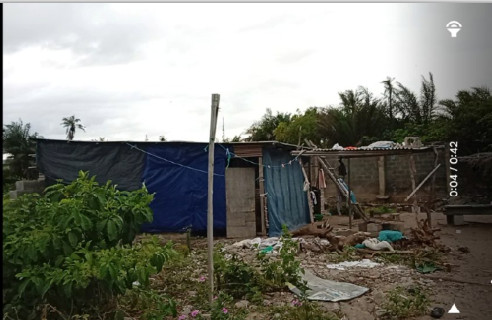
Mrs Tolani Adeleke, a pastor’s wife at Idotun, said ocean surges have destroyed their church, which serves as their home four times, forcing them to relocate inland each time.
She said that in Idotun, ocean surges occur every six months. Adeleke, who now lives in a shanty with her husband and children, calls for government help.
“Natural Challenge”
The Lagos State Commissioner for Waterfront Infrastructure Development, Hon. Yacoob Ekundayo Alebiosu, dismissed claims that the Eko Atlantic City project is the primary driver of coastal erosion, describing the phenomenon as a “natural” challenge requiring global expertise and massive investment.
He added, “If people say Eko Atlantic caused the erosion, we must ask ourselves: what caused Victoria Island’s erosion in the first place?”

Alebiosu
Alebiosu acknowledged the fears of coastal communities witnessing land loss, even if the direct scientific link to specific projects remains debated.
He admitted that illegal dredging remains a major challenge but clarified that it occurs mostly in the lagoon rather than the Atlantic.
But a Community leader in Okun Alfa, Honourable Sheriff Elegushi, lamented: “Even our central mosque, road, transformer, and high-tension poles are gone! Our children attend schools in other communities. Our shops and businesses disappeared with our land.”
Like others, he blames dredging for the Eko Atlantic project, describing a divide in which land reclamation for the wealthy has led to land loss for the poor.
His words: “That dredging weakened our land and allowed the ocean to erode it. Poor people are suffering while the rich benefit. We want our lost land reclaimed by pumping sand back, just as it was done for Eko Atlantic.”
While appreciating the installation of the wave breakers, Sheriff said a long-term solution was needed to check ocean surges.
He revealed that just a week before the reporter visited, the ocean surged, reaching where buildings had been cited before receding. He expressed frustration with the government’s inaction.
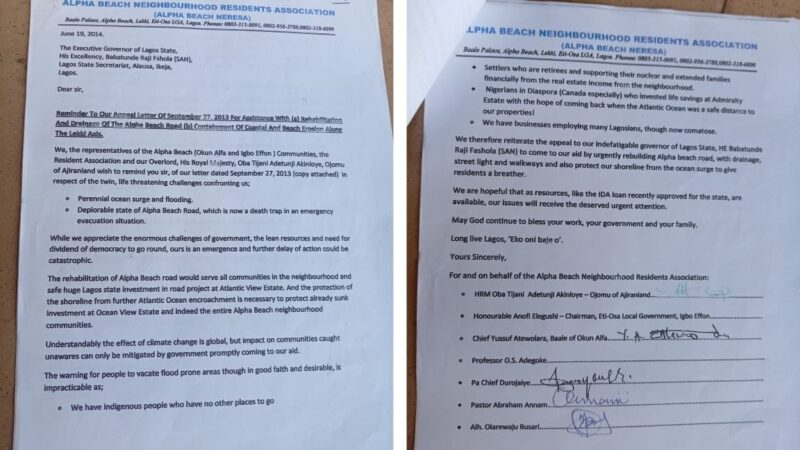
He disclosed that the community has petitioned the government for assistance multiple times, including the most recent request sent last November 2025.
Disappearing Coastlines: Lagos on the Brink
“Over 84 per cent of the city’s coastline has receded over the past 50 years due to a combination of unchecked coastal erosion, rising sea levels, and human activities,” according to a Report cited by The Punch in 2025.
Another 2021 Report by Lagos State, ‘Lagos State Climate Risk Assessment,’ says:
“Vulnerability assessment obtained in this study indicates that features located along flood plains, riverbanks, and along the Atlantic Ocean, especially the Alfa Beach axis, have the highest degree of vulnerability to the threat of ocean surge.”
The report further states that the Eko Atlantic City project has worsened ocean surges, leading to the loss of over 350 metres of community land.
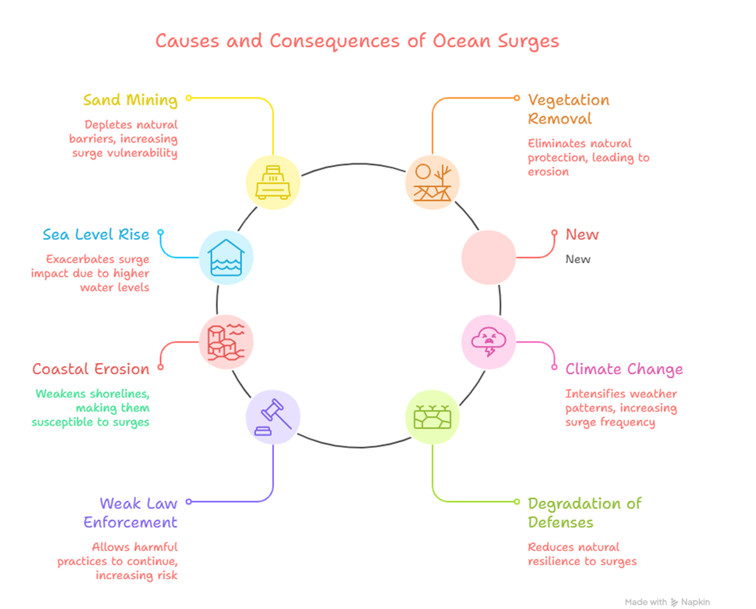
The Report notes that in the distant future beyond 2050, “it is estimated that about 1,319 buildings within three Coastal Local Government areas will show signs of unequal settlements and structural failure in the form of cracks and sinking.”
The Report says, “The coastal local Government areas are in constant threat of subsidence, a consequence of the cumulative effects of drilling activities and the sea level rise. The implications of the observed and projected coastal subsidence in Lagos are that there will be more water on land for up to 4 months each year.
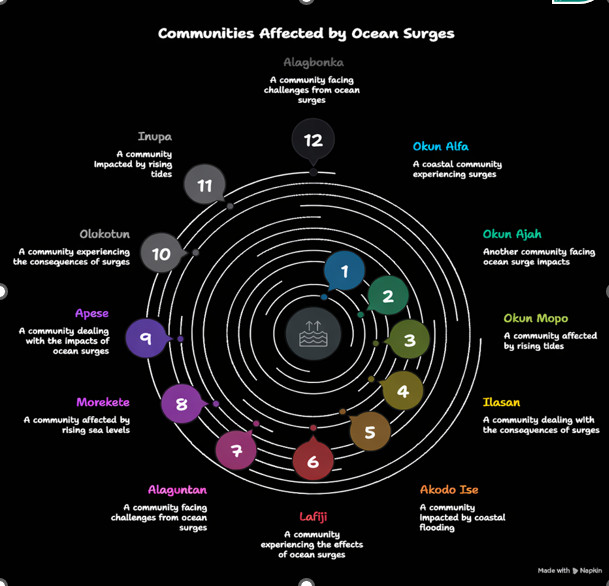
Communities like Okun Alpha, located along the city’s coast in the Eti-Osa Local Government Area, will be most affected, according to the report. It states that those who will be most impacted are, “Epe, Ikorodu, Ojo, Ibeju Lekki, Eti Osa, Badagry and some parts of Kosofe.”
According to the Nigerian Conservation Foundation, Lagos loses approximately 2–30 meters of coastline each year, adding that over the past 10 years, more than 3,000 people have been displaced in the Eti-Osa Local Government Area alone, despite ongoing government interventions.
Dr Joseph Onoja, a Nigerian environmental scientist and conservation expert who currently serves as the Director-General of the Nigerian Conservation Foundation (NCF), said ocean surges are caused by a combination of human activities and natural factors.
He said the Eko Atlantic project protected Victoria Island but shifted erosion eastward. He also cited the destruction of mangroves and vegetation.
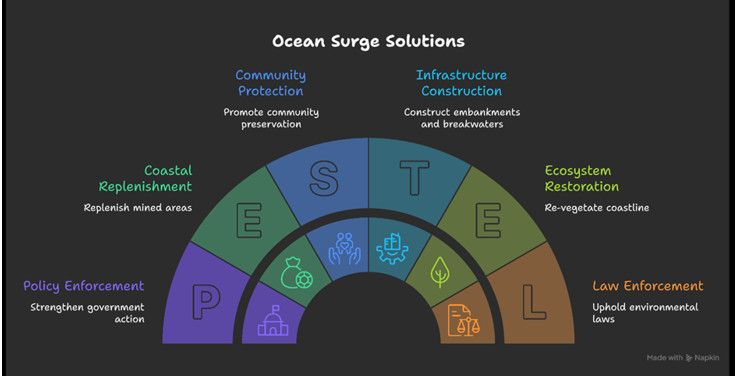
“The coastline was left at the mercy of the strong Atlantic waves. Adding to this, we now face rising sea levels. All these factors combined have worsened the situation, leading to communities being washed away. The government has a role to play, which involves creating policies and enforcing laws. People still engage in sand mining along the coastline, which further degrades the coast and exposes it to more erosion.”
Right To Shelter
The Nigerian Constitution requires the government to ensure everyone has a decent and safe place to live. However, in reality, many people are not protected and are being forced off their lands.
This goes against the United Nations’ Sustainable Development Goal 11.
Residents say failure to enforce sand mining policies has worsened their situation.
Noheem Babatunde Adams, lawmaker representing Eti-Osa Constituency I, declined to speak on relocation or compensation plans for Okun Alfa.
“You have to go to the Ministry of Waterfronts. I’m a lawmaker; they are the ones responsible, not me,” he said.
The African Cities Research Consortium (ACRC) further states:
“APC conceptions of the beautification and modernisation of the city have entailed a slew of highly violent slum clearances, the banning of modes of informal transportation, and support for the development of upper-middle-class and elite housing enclaves and real estate projects, most dramatically reflected in Eko Atlantic.”
A researcher with ACRC and Senior Lecturer in Geography at the University of Lagos, Professor Peter Elias, said that human activity intensifies natural processes, and that displacement will worsen inequality without inclusive planning.
Elias, however, has a message for the government.
His words: “ Governments can protect coastal communities, but the question is whether they are willing. They have legislative power to enact protective laws, economic power to provide alternatives and compensation, and political power to prioritise citizens’ rights. However, in many settings, governments lack sensitivity to the needs of their people. Inclusive, sustainable city development is often missing from policies.
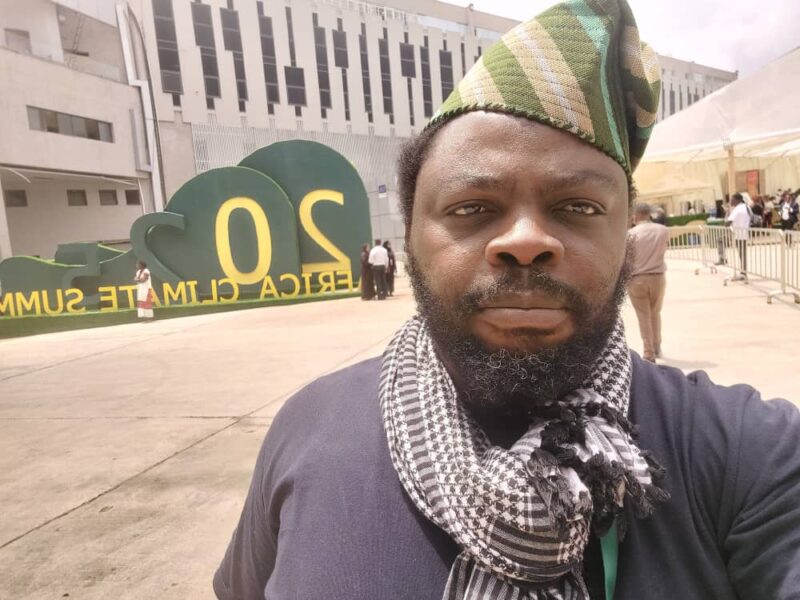
An environmentalist, Mr Sulaimon Arigbabu of HEDA Resource Centre, warned that climate change could put coastal cities at risk and called for sustainable, inclusive policies.
“Protecting only the wealthy while exposing poorer communities to nature’s challenges will create societal problems. Policies must be inclusive and consider all social strata,” he said.
The South EnergyX Nigeria Limited did not respond to requests for comment.
This report was facilitated by DevReporting in partnership with Pro-Poor Development Media Network (PDM-Network) and supported by the African Cities Research Consortium (ACRC).
#OkunAlfa #AlfaBeach #LagosState #Oceansurges #EkoAtlantic #DubaiofAfrica #ACRC
#DevReporting