
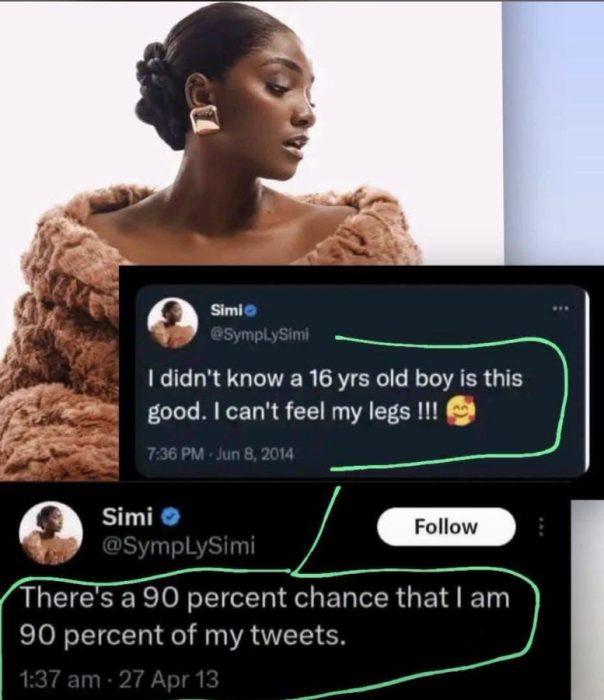

The Lagos State Domestic and Sexual Violence Agency (DSVA) and the National Agency for the Prohibition of Trafficking in Persons (NAPTIP) have addressed the growing public outcry surrounding singer Simisola Kosoko, popularly known as Simi, following the resurfacing of a series of controversial tweets from a decade ago.
Securitynewsalert.com heard that the tweets, dating back to 2012–2014 when the singer worked at her mother’s daycare, have caused a heated national debate over child safety, gender double standards in the law, and the permanence of digital footprints.
Speaking on Channels Television’s Morning Brief, the Executive Secretary of the Lagos State DSVA, Lola Vivour-Adeniyi, emphasised that while the agency is aware of the public concern, a formal prosecution requires more than social media history.
“It is going to be very difficult to prosecute Simi without a survivor being present,” Vivour-Adeniyi stated. “To start the process, we encourage anybody who was allegedly sexually assaulted by Simi to please come forward and ensure that their statement is taken.”
NAPTIP echoed this sentiment, noting that while they are willing to investigate credible reports of child abuse, their investigations are based on substantiated evidence, not rumour or online speculation.
The controversy began when users on X (formerly Twitter) unearthed posts from the singer’s early twenties.
Critics argue the posts contain “self-confessions” of inappropriate behaviour toward children at the daycare, while supporters claim they were “edgy” jokes or “engagement farming” typical of early Twitter culture.
Legal experts have noted that the singer was approximately 23 years old at the time of the posts.
Barrister Street (BSN), a legal commentator, noted that the passage of time creates significant hurdles.
Under the Child Rights Act (2003) and the Evidence Act, criminal prosecution requires corpus delicti admissible proof.
BSN further explained that speculation, interpretation of historical posts, or hearsay cannot substitute for legally sufficient evidence.
The DSVA’s stance has met with sharp resistance from many Nigerians on social media, who have drawn comparisons to the recent arrest of content creator Speed Darlington.
Many users argued that if a male artist had posted similar content, the legal machinery would have moved faster.
User @JezebelReborn noted that if it were a man, agencies would already know how to do their job, but because it is a woman, the story is different.
Critics also pointed to the swift police action against Speed Darlington as a stark contrast.
@OviPayne questioned if authorities waited for a victim before declaring Darlington “wanted,” while labelling the current excuses for Simi as hypocritical.
Others believe the onus should be on the state to find victims. @Slick_stanley argued that the investigation should start by obtaining daycare records and contacting parents rather than sitting on their hands and waiting for survivors to come forward.
Beyond the legalities, branding experts suggest the “Duduke” singer’s reputation may face long-term damage.
While Simi has not been charged with any crime, the “Twitter Police” have already rendered a verdict in the court of public opinion.
MDA (@MDApieA2) observed that whether survivors come forward or not, these tweets have seriously damaged her brand and credibility, suggesting she now carries a label that may affect her international reach.
#https://securitynewsalert.com/