
By Nnamdi Ikeh-Akabogu (FRSCN)
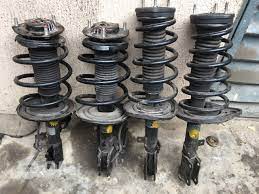
Shock absorbers are safety devices often neglected that aid in keeping your tyres in contact with the road at all times.
Springs cushion a vehicle’s ride, but without shock absorbers to dampen the springs’ compression and expansion, a vehicle would keep bouncing after riding over rough streets or sinking into potholes.
Functions of Shocks:
– Shock absorbers keep your car’s tires flat against the surface of the road, providing even pressure so the tread wear remains consistent.
– It absorbs vertical up-and-down impacts and movements for the rear axle and front-end suspension.
– Without shock absorbers, the vehicle’s ride would be noticeably rough and jarring, causing other components to wear much faster than normal…
SIGNS OF A BAD SHOCK ABSORBER:
– Shock Height:
All sides of the vehicle should remain within a few inches of each other if the tyres have the exact pressure and the front end suspension parts have no damage or wear.
Any noticeable deviation in height can indicate a weakened or leaking shock tube.
– Excessive Bouncing:
Excessive bouncing or rebounding when the vehicle rolls over driveway lips or bumps can point to shocks that have lost their dampening effect.
– Leaks:
Any visual leaks around the shock body tube, either at the top or body of the shock, indicate that the seals have worn or split. As a result, there is a loss in hydraulic fluid, and all dampening effect has disappeared.
– Undercarriage Noises:
Loud clanking or knocking noises coming from the undercarriage, when driving over bumps or curves, may indicate a broken shock mount.
– Tyre Wear:
Worn shocks cannot keep the tires firmly planted on the road surface.
– Excess Lean and Suspension Noise:
If the vehicle leans excessively into a tight or gradual turn, this means the shock cannot maintain its height and has lost the ability to carry the frame’s load.
The traffic expert is DCC Nnamdi Ikeh-Akabogu, DCC Morning and Evaluation (M&E), Special Duties and External Relations (SEDER), FRCC HQ, Abuja