
By Juliana Francis
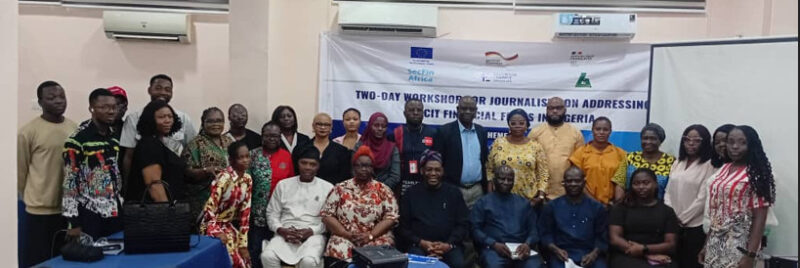
Journalists, media practitioners and civil society representatives recently gathered in Ikeja, Lagos State, for a workshop aimed at strengthening the media’s capacity to investigate and report on corruption and illicit financial flows (IFFs) in Nigeria.
The workshop was organised by the Africa Network for Environment and Economic Justice (ANEEJ) in partnership with SecFin Africa and the Nigerian Financial Intelligence Unit (NFIU), under the project, “Strengthening CSOs and Media Capacity to Promote Transparency and Accountability.”
The initiative is being implemented with support from the European Union.
According to the organisers, the training was designed to sharpen participants’ investigative skills, deepen their understanding of how illicit financial flows operate, and foster stronger collaboration among journalists, civil society organisations and anti-corruption institutions.
They described such partnerships as essential to curbing the vast resources Nigeria loses annually to corruption, money laundering and related financial crimes.
The organisers noted that corruption remains one of the greatest obstacles to Nigeria’s development.
Speaking at the opening of the workshop, the Editor-in-Chief and Chief Operating Officer of Premium Times, Musikilu Mojeed, described corruption as the country’s biggest impediment to progress.
He commended the organisers for offering the training free of charge, noting that similar programmes elsewhere often cost participants hundreds of dollars.
“We are discussing procurement, corruption, money laundering and transparency. These are complex but critical issues that we all need to understand,” Mojeed said.
He urged journalists to expand and deepen investigative reporting on corruption, stressing that specialised training opportunities should be extended to more states and reporters across the country.
“The major problem we face in our country is corruption. If we don’t tackle it, our nation cannot make the progress it deserves,” he said, adding that building journalists’ capacity to report accurately on financial crimes is crucial to national development.
Mojeed also encouraged participants to share the knowledge gained with colleagues after the workshop.
Ms Aisha Bantam, delivering the NFIU’s goodwill message, described the media as one of the most powerful institutions in a democratic society, saying its role in exposing financial crime is indispensable.
“Every illicit dollar that leaves Africa unlawfully represents a school not built, a hospital not equipped, a road not completed, or an opportunity denied to future generations,” she said.
She described the fight against illicit financial flows as both a national security priority and a development imperative.
Bantam explained that financial crimes have become increasingly sophisticated, transnational, and technology-driven, with criminal networks exploiting weaknesses in financial systems, transferring illicit funds across borders and concealing the proceeds of crime through complex ownership structures.
“Exposing such schemes requires informed, ethical, professional and dedicated journalism,” she said.
She highlighted the NFIU’s support for investigations into corruption, money laundering, terrorism financing, organised crime, kidnapping for ransom, cyber-enabled fraud, and oil theft.
She also pointed to the Joint Financial Intelligence Collaboration (JFIC), which brings together government agencies and the private sector, as an internationally recognised model for combating financial crime.
According to Bantam, the NFIU has also advanced beneficial ownership transparency, strengthened targeted financial sanctions and improved intelligence-sharing frameworks to protect the integrity of Nigeria’s financial system.
With Nigeria preparing for its 2027 Financial Action Task Force (FATF) Mutual Evaluation, she said the media has a crucial role in shaping public understanding of financial integrity issues.
“Accurate reporting on corruption, money laundering, beneficial ownership, terrorism financing, sanctions implementation, asset recovery and financial transparency contributes significantly to building a culture of accountability and compliance,” she stated.
While noting that financial intelligence is confidential by nature, Bantam said the NFIU remains committed to engaging more closely with journalists.
Representing SecFin Africa, Professor Abdullahi Shehu told participants that illicit financial flows, driven by corruption, money laundering, tax evasion, trade misreporting, procurement fraud and profit shifting, continue to divert enormous resources from productive use in Nigeria and across Africa.
“Every naira lost to illicit financial flows is one less available to fund education, healthcare, infrastructure, social protection, environmental sustainability and public trust in government,” he said.
Although Nigeria has established legal, policy and institutional frameworks to combat illicit financial flows, Shehu argued that effective implementation depends on active citizen engagement and scrutiny, a role journalists are uniquely positioned to play.
He said journalists have historically contributed to preventing illegal financial outflows, recovering stolen assets, exposing corruption, strengthening public oversight, and driving policy reforms both in Nigeria and internationally.
However, he cautioned that the evolving nature of financial crime requires journalists to develop expertise in Nigeria’s political and institutional systems, anti-corruption agencies, freedom of information laws, investigative techniques, data journalism and digital security.
“As journalists, your work is not merely about reporting events. It is about helping citizens understand issues that affect their lives,” Shehu said, describing the fight against illicit financial flows as a shared responsibility that cannot be left to government institutions alone.
He also outlined the scope of the EU-backed project, noting that it has earmarked €26 million to help African countries strengthen anti-money laundering systems and combat financial and economic crime.
The initiative is being implemented through four regional hubs, with West Africa coordinated from Senegal, while Nigeria has been designated a priority country because of its size and regional influence.
Shehu commended local partners, including Lagos Television and Premium Times’ Premium Channels, for supporting the initiative.
He also expressed hope that increased scrutiny of non-governmental organisations would not be used to restrict civil society’s role in monitoring government activities and demanding accountability.
The workshop comes amid renewed continental concern over the scale of illicit financial flows from Africa. Independent organisations, including the United Nations Economic Commission for Africa, have long estimated that the continent loses tens of billions of dollars annually to such resource flows that could otherwise finance public services, infrastructure and social protection.
Nigeria, Africa’s largest economy and most populous nation, continues to attract significant attention from international anti-corruption and financial crime experts because of the scale of both illicit financial outflows and ongoing enforcement efforts.
Throughout the workshop, speakers linked the issue of illicit financial flows directly to Nigeria’s development challenges, arguing that resources lost to corruption translate into underfunded schools, overstretched hospitals, poor infrastructure and weakened public trust in government.
A recurring theme was that many of the world’s most significant exposés on corruption, money laundering and tax evasion originated from investigative journalism rather than law enforcement alone. Speakers argued that a well-trained and independent media serves as a frontline defence against financial crime by uncovering patterns and evidence that might otherwise remain hidden.
Organisers explained that the workshop combines technical training on financial crime typologies with practical instruction on investigative methods, data journalism and digital security. Participants were also expected to gain a better understanding of Nigeria’s anti-corruption institutions, including their mandates and limitations.
Although financial intelligence remains confidential, organisers stressed that journalists can still strengthen their reporting by understanding how illicit financial flows affect governance, investment, economic stability, and national security.
The workshop also emphasised sustained collaboration among journalists, civil society organisations and government institutions. Participants were encouraged to maintain the professional networks formed during the training and continue engaging with resource persons after the programme.
Speakers acknowledged the delicate balance between regulating non-governmental organisations and preserving civil society’s watchdog role, expressing hope that transparency requirements would not become a pretext for limiting independent oversight.
Across the goodwill messages and keynote presentations, one message remained consistent: combating corruption and illicit financial flows in Nigeria requires not only law enforcement and financial intelligence agencies, but also a well-informed, technically skilled and independent media.
Organisers said the workshop would provide practical guidance on developing investigative stories, understanding financial crime typologies, using public records and applying digital tools to trace illicit financial transactions.
They expressed hope that the training would produce more evidence-based investigative reporting capable of exposing corruption, strengthening public accountability, and helping recover resources that could be invested in schools, hospitals, and infrastructure across Nigeria. #Securitynewsalert.com